
llms.txt MCP and Schema for AI Search in 2027
Before adding another AI feature to your website, check whether the systems you want to reach can access your important pages and understand what your business offers. A blocked service page, conflicting business details or an unreadable product specification deserves attention before an optional integration.
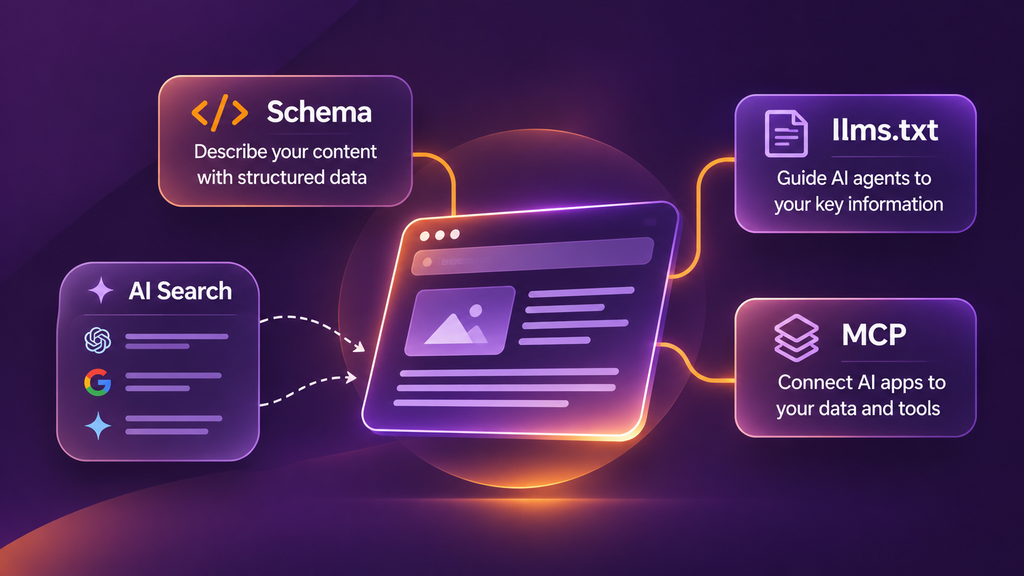
Schema, llms.txt and Model Context Protocol serve different purposes. Schema describes information. An llms.txt file offers guidance to agents that choose to use it. MCP connects an AI application to tools and data. Treating all three as requirements for AI search can send a business towards work that does little to solve its actual visibility problem.
For businesses planning their 2027 SEO priorities, the useful question is where each technology fits and what evidence would justify implementing it.
Start with access to your important pages
A customer may find your business through Google, ask an assistant to compare suppliers, or use a browser agent to inspect your website. Those experiences can involve different systems with different access and rendering capabilities.
Start with a representative sample of service pages, product pages and evidence such as case studies. Confirm that each public page returns the intended content, has the correct canonical URL and is linked from relevant parts of the website. Check whether essential information is available as readable text rather than only in images or interactions that a particular fetcher cannot complete.
Then compare those checks with server and firewall logs. A successful browser visit does not establish that another client can retrieve the same page. Our guide to website visibility for AI agents explains why access and rendering need separate checks.
Search crawling and model training have separate controls
OpenAI documents separate roles for its crawlers and user agents. OAI-SearchBot supports ChatGPT search discovery, GPTBot relates to potential model training, and ChatGPT-User handles certain visits initiated by users. The settings are independent; user-initiated requests also have different robots.txt considerations.
Review the provider’s current documentation before changing access rules. Verify requests using the published verification method or IP information where available. A user-agent name alone can be copied. Avoid broad firewall exceptions based only on a bot name, and check that a rule change has not affected other search crawlers or ordinary visitors.
What schema can help you describe
Structured data uses a shared vocabulary to describe information on a page. It can clarify the relationship between a business, its services, its authors and its content. Supported markup can also make a page eligible for particular Google search features.
Google’s structured data guidelines require accurate markup and make clear that correct implementation does not guarantee a rich result. Schema validity, search feature eligibility and an AI citation are different outcomes.
For a service business, choose types that fit the information being described. Organisation details should identify the real business. A Service can describe an actual service and its provider. An Article or BlogPosting can identify the author and publication details of an article. Use LocalBusiness where it accurately represents the business, and maintain consistency with visible contact and location information.
The Schema.org Service definition supports properties such as provider and areaServed. That does not mean every Schema.org type has a dedicated Google rich result. Choose markup for accuracy, then check the requirements of the specific search feature you are targeting.
Review conflicting markup before adding more
Several JSON-LD blocks on one page can be valid. A plugin might describe the website while another block describes the article. The useful check is whether those blocks agree and refer to the correct entities.
Look for an old company name, an incorrect author, a service described as the wrong offering, or a location copied across every page. Use stable identifiers where appropriate so related records refer to the same business. Compare the markup with the page customers can actually read.
Validate the vocabulary with Schema Markup Validator and use Google’s Rich Results Test for supported Google features. Neither test establishes that an assistant will recommend the business.
Where llms.txt fits
The llms.txt proposal describes a Markdown file that can guide agents towards useful information. Its role is particularly understandable for a documentation library where an agent needs a concise route to relevant reference material.
A business can use the same idea to point towards public service information, policies and supporting resources. However, usefulness depends on whether a particular system consults the file and how it uses the contents. Publishing the file does not establish that it influences a search result.
Google’s guidance on generative AI search explicitly says Google Search does not use llms.txt for visibility or rankings. The file is optional for other systems that use it. It should not be sold as a requirement for inclusion in Google’s AI search experiences.
Keep an optional file small and accurate
If you maintain llms.txt, include a clear business description and a short selection of useful public resources. Check that its links resolve to the intended pages. Review it when services, policies or URLs change.
The file is not an access-control mechanism. It cannot protect private information, replace authentication or override robots.txt. Treat any information you publish there as public.
For a Melbourne consultancy with a small website, fixing inaccessible service information is likely to be a more useful first task. For a software company with extensive documentation and an audience using coding agents, maintaining an agent-oriented index may have a clearer purpose. The decision should follow the use case.
What MCP connects
Model Context Protocol is an open protocol for connecting AI applications with external tools and data sources. A business might use an MCP server to make an approved catalogue lookup or internal reporting tool available to a compatible assistant.
That requires an actual integration. The client needs a way to connect, the server needs appropriate permissions, and the business needs to decide what information or actions it will expose. Adding an MCP server does not automatically place ordinary website pages in search results.
Consider a supplier that wants an authorised assistant to check current stock. MCP might support that workflow. A supplier that wants its capabilities page to rank for a manufacturing service has a different task: publishing useful information and making it accessible to the relevant search systems.
WebMCP concerns interaction within a website
WebMCP is a related browser-facing initiative for exposing website functionality as tools to agents. Its current specification is a draft Community Group report, rather than a W3C Standard.
Assess browser and agent support before committing development time. A demonstration of an agent completing a task does not prove universal compatibility or an improvement in search visibility. Keep a usable human journey, and define permissions and confirmation steps for actions that change data or create commitments.
Choose the work that matches the problem
| Observed problem | Sensible first action | Evidence to collect |
|---|---|---|
| A relevant crawler receives an error | Inspect server and firewall rules | Verified requests and returned content |
| Business details conflict across markup and pages | Correct the underlying information and schema | Consistent public details and validated markup |
| Agents struggle to navigate a large documentation library | Test clearer navigation and an optional llms.txt index | Successful retrieval of the intended reference pages |
| An authorised assistant needs live business data | Assess an MCP integration | Correct responses within defined permissions |
| An agent needs to complete an on-site task | Test the existing interface and supported WebMCP options | Task completion in the specified environment |
If you need help prioritising these checks, our AI SEO agency in Melbourne can assess the barriers affecting your most valuable pages.
Measure the outcome of each change
Record the problem, the change and the result you expect before implementation. If the issue is access, verify access afterwards. If the issue is inconsistent information, confirm that the source pages and markup now agree. An increase in citations after several simultaneous changes cannot isolate the effect of a single file or protocol.
Track search visibility and identifiable referrals alongside qualified enquiries and sales where those connections can be established. Our guide to measuring AI search ROI explains how to keep those measures separate.
For a prioritised plan covering technical foundations and commercial search opportunities, explore our SEO services Melbourne.