
How to Measure AI Search ROI: A Practical Guide for Australian Businesses
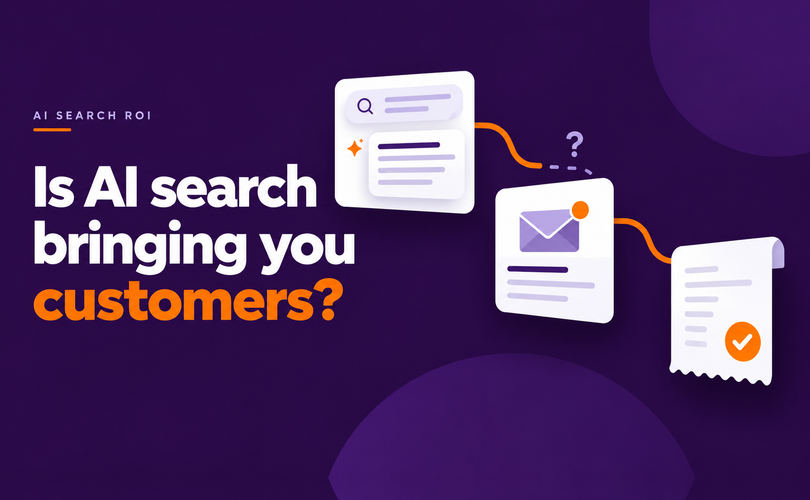
Your business appears in ChatGPT. You have screenshots, a visibility report and perhaps a few visits coming through. But is any of this bringing you customers?
It is a fair question. If you are investing time and money in AI search, you should be able to understand what you are getting back.
The difficulty is that the journey is not always easy to follow. Someone might ask ChatGPT for a recommendation, Google your business name and then enquire. Your report credits Google. The AI recommendation that helped them find you disappears from the picture.
We also cannot assume that every increase in branded searches came from AI. So how do we measure it properly?
There is no perfect number, but there is a sensible way to approach it. Start with the visits you can identify, follow the enquiries through to sales and ask customers how they found you. Then compare those results with what you spent.
Why this matters for Australian businesses
Australian businesses are making decisions about AI search while customers are changing how they research and compare providers.
In September 2026, B&T reported on WPP Media research involving 2,500 Australians across 12 categories. The study reported that three in four used AI search to help with purchase decisions.
That figure includes AI summaries in conventional search results, alongside direct use of tools such as ChatGPT, Gemini and Claude. It does not mean three in four Australians are shopping through ChatGPT. The distinction matters when we use these numbers to make business decisions.
The budget question matters too. In its 29 September 2026 statement, the Reserve Bank raised the cash rate to 4.60% and noted ongoing business cost pressures.
For a business owner, another marketing investment needs a clear reason. How will it help customers find you? What will you measure? And what would justify continuing to spend?
What does the Australian data actually show?
There is Australian research on AI referrals and conversions, and it gives us a more useful starting point than broad claims about how well AI traffic performs.
Optimising’s Australian AI Traffic Study analysed 115 businesses, including 61 ecommerce businesses and 54 service or lead-generation businesses. It reported strong growth in identifiable AI traffic, although AI-attributed ecommerce revenue was still around 0.1% of the sample’s total.
Its reported AI purchase rate was 2.9%, compared with 6.0% for organic traffic. The study also noted limitations around missing referral information and small samples for some platforms.
Lawrence Hitches’ 100-brand ecommerce report covered Australian ecommerce data from July 2024 to March 2026. It reported a ChatGPT conversion rate of 0.9%, compared with 1.2% for Google organic, with considerable differences between product categories.
These are different samples, time periods and reporting approaches. We should not average them together or use either as a promise of what an individual business will achieve.
Our view is that your own customer journey needs to guide the measurement. An online purchase can happen within minutes. A clinic booking may follow several visits. A mortgage enquiry could take months to become settled business. The reporting needs to account for those differences.
Decide what you want AI search to achieve
Before opening another dashboard, decide what you are trying to improve.
For a retailer, that could be profitable sales. For a clinic, suitable new-patient bookings. For a professional service, qualified enquiries that become paying clients.
You can then work backwards through the journey:
| What to track | What it helps you understand |
| Brand mentions and citations | Are you appearing in the answers you test? |
| Identifiable AI referrals | Are people clicking through to your website? |
| Qualified enquiries, bookings or purchases | Are those visits leading to useful outcomes? |
| Closed sales and gross profit | What value did those customers bring to the business? |
A mention is worth recording. A lead is worth investigating. A paying customer gives you something firmer to assess.
This is where we would be careful with an AI visibility report. It can show progress in the questions being monitored, but you still need to connect that progress with your business goals.
Follow AI referrals beyond the first visit
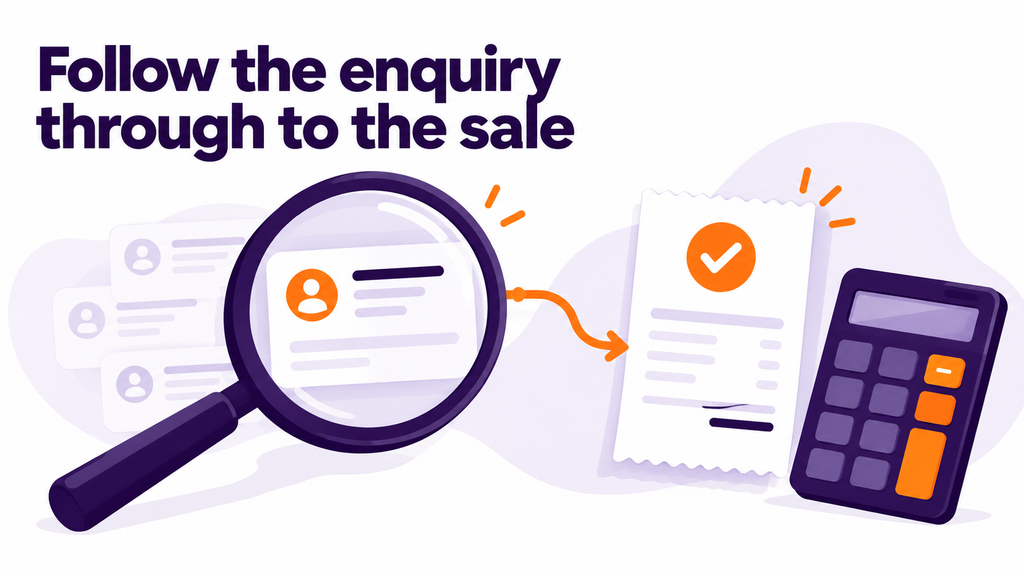
Start with the AI referrals you can identify in your analytics. Review which pages people land on and whether they enquire, book or purchase.
Where possible, carry that source information into your enquiry records or CRM. Otherwise, the reporting often stops at “we received a lead”, without anyone checking what happened next.
For a clinic, follow the enquiry through to a confirmed appointment and attendance. For a mortgage broker, check whether the enquiry was suitable and whether it eventually became settled business.
Keep the platforms separate where you have enough data. The same brand can be presented differently by ChatGPT and Perplexity. Monitor those differences alongside referral outcomes rather than assuming one platform represents them all.
Also look at the actual numbers. One sale from five visits produces an impressive conversion rate, but it is too small a sample to plan a budget around.
Ask customers how they found you
Sometimes the simplest question adds information that your tracking cannot capture.
Include “How did you hear about us?” in your enquiry, booking or onboarding process. Make AI tools one of the options and allow more than one answer. You can also ask during a sales conversation whether ChatGPT or another AI tool helped the customer find or compare providers.
Someone might say, “ChatGPT recommended you, then I looked you up on Google.” That gives you useful context for a visit your analytics recorded as organic search.
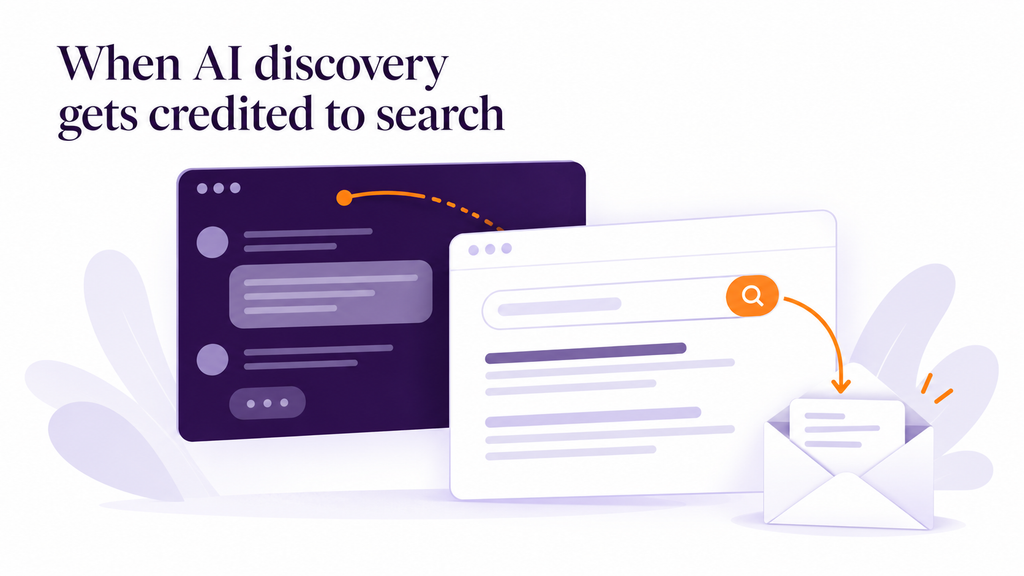
Keep their response against the same customer record. If they also appear in your tracked AI referrals, count the customer once.
Customer feedback has limits too. Some people will not answer, and others will only remember the last step. Report the response count and avoid assuming a small group speaks for everyone.
Work out the return using profit and costs
Ahrefs’ AI search ROI guide provides a helpful framework for separating AI-specific costs from shared SEO costs and estimating revenue through tracking and customer feedback.
We would also look at gross profit. A business can generate revenue and still make very little after paying to deliver the product or service.
A practical calculation is:
Estimated AI search ROI = (gross profit attributed to AI search − AI search campaign cost) ÷ AI search campaign cost × 100
Here is a hypothetical example:
- You spend $3,000 on the relevant AI search work.
- You record ten qualified enquiries associated with identifiable AI referrals.
- Three become paying customers.
- Those customers generate $4,500 in gross profit.
Your estimated return is ($4,500 − $3,000) ÷ $3,000 × 100, or 50%.
This is a worked example, not a Predicta client result. It assumes you have allowed enough time for the enquiries to become customers and included the relevant campaign costs. The figure describes the return under your attribution method; it does not prove that AI search alone created those sales.
If you only have enquiries so far, you can estimate their potential value using your usual close rate and gross profit per customer. Keep that labelled as a forecast, then update it when you know what actually closed.
Be realistic about shared SEO costs
Your costs might include agency fees, tracking tools, content work, technical improvements and your team’s time.
Some of that work will support both Google visibility and AI search. A clearer service page can help a customer whichever platform brought them there.
Use a reasonable allocation of shared costs and explain it. If your campaign covers both SEO and AI search, assess the overall return as well. There is little value in forcing a precise split when the same improvements serve both.
How much of the wider growth can you credit to AI?
This is where reporting can become a little too generous.
An increase in direct traffic or branded searches might follow an AI recommendation. It could also follow an ad campaign, PR coverage, referrals or seasonal demand.
We would report three things separately:
- Sales associated with identifiable AI referrals.
- Sales where customers say AI influenced their decision.
- Wider changes in branded search, direct traffic and enquiries.
The first two can be connected to customer records, with any overlap removed. The third adds context, but needs more evidence before we assign the growth to AI.
It is perfectly reasonable to say, “We are seeing these changes at the same time, and we are investigating the connection.” That is more useful than giving AI credit for every improvement.
When should you invest more?
Record a baseline before making substantial changes and choose a review period that suits your sales cycle. Keep track of other activity too, including advertising, PR, website changes and promotions.
If AI mentions are increasing but suitable enquiries are not, look at where you are appearing. Are those questions relevant to your buyers? Do they relate to the services you want to grow? Does the landing page make the next step easy?
If enquiries are growing, check lead quality and closed sales before increasing the budget. More enquiries only help if they are suitable for the business and you can convert them.
We would also compare this with the channels already producing results. AI search can be part of your growth strategy, but the budget decision should be based on evidence from your business.
What we would ask for in an AI search report
As a business owner, you should be able to see where you are appearing, what visits and enquiries you can identify, which customers mention AI, and what happened to those enquiries.

You should also understand what the work cost and where the figures rely on estimates.
That gives you a basis for deciding what to improve, what to continue and whether to invest more. The reporting will never capture every part of the journey, but it should help you make a clearer decision.
At Predicta Digital, we help businesses review their AI search visibility alongside SEO performance and the outcomes they want to achieve. If you want to understand where you appear and what to measure next, get in touch with Predicta Digital.
At Predicta Digital, we help businesses review their AI search visibility alongside SEO performance and the outcomes they want to achieve. If you want to understand where you appear and what to measure next
Get in touch with Predicta DigitalSources and Australian economic context reviewed as at 9 October 2026. The external studies describe their own samples. The ROI example is hypothetical.