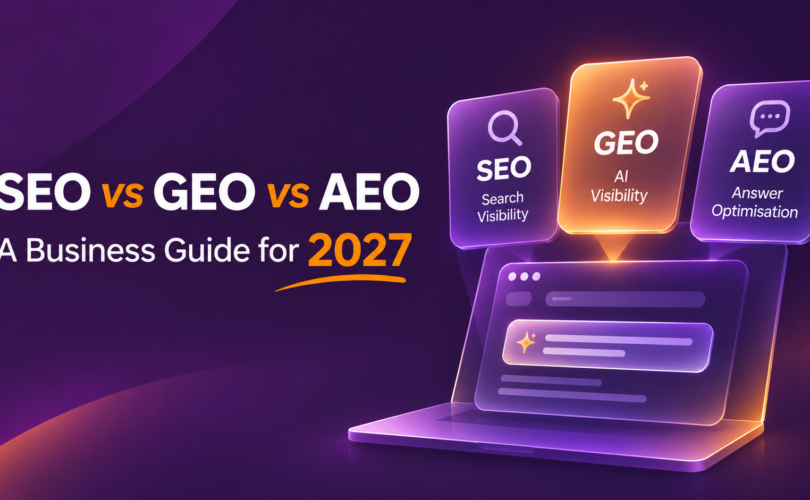

SEO vs GEO vs AEO What Businesses Need to Know for 2027
SEO, GEO and AEO describe overlapping work to help people find and use information. The distinction becomes useful when it clarifies what a business is buying, where it expects to appear and how results will be assessed.
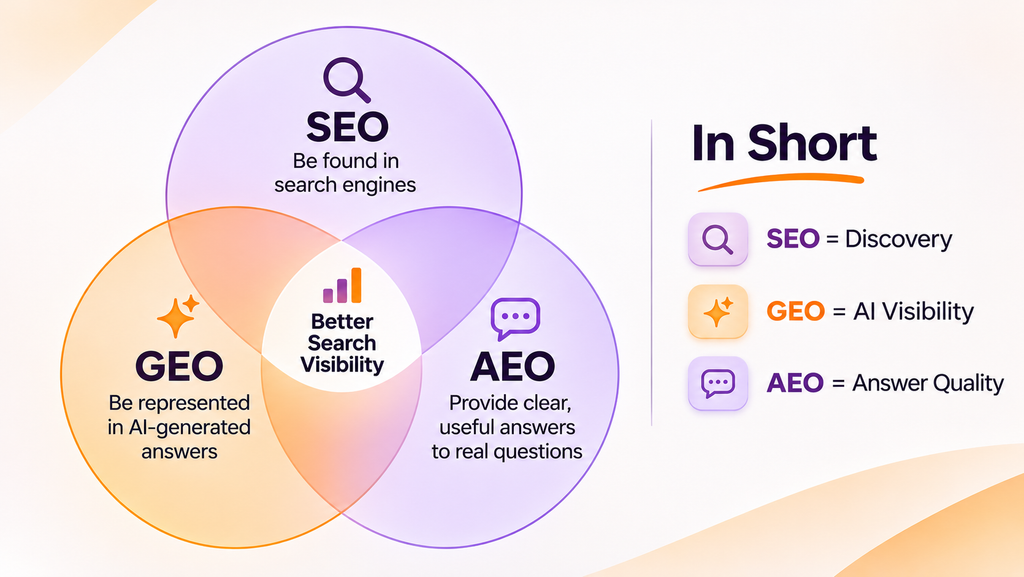
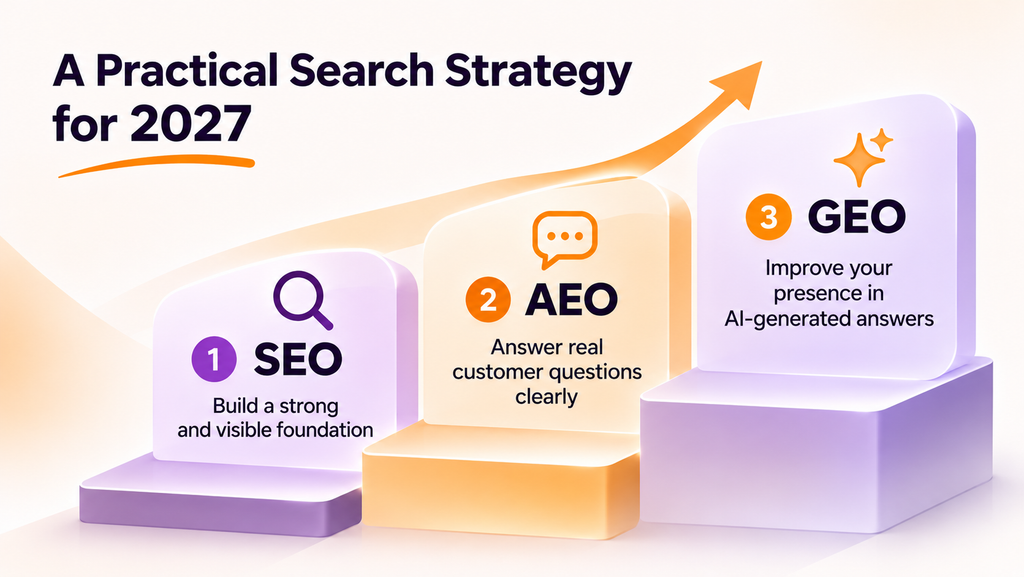
SEO covers visibility in search engines. GEO generally concerns visibility in generated answers. AEO focuses on providing answers to questions. These labels do not create three separate sets of customers or remove the need for reliable website information.
For an Australian business planning its 2027 marketing budget, the important task is to connect each proposed activity with a customer need and an observable outcome.
SEO supports discovery through search engines
Search engine optimisation helps search engines access, interpret and surface relevant information from your website. It includes technical work, content, internal linking and other activities that support useful search visibility.
A manufacturer might improve a page about a particular cutting capability so buyers can assess its materials and specifications. A professional services firm might clarify which advice it provides and publish evidence of relevant expertise. Both activities can help prospective customers understand whether to make contact.
SEO also applies within a search environment that includes AI-generated answers. Google says its established SEO practices remain relevant to AI Overviews and AI Mode. It does not require a separate technical optimisation layer for inclusion in those features.
Evaluate SEO through relevant search visibility, useful visits and commercial outcomes. Rankings can support diagnosis, but a ranking improvement alone does not establish that the business gained suitable customers.
GEO focuses on visibility in generated answers
Generative engine optimisation is commonly used to describe work aimed at improving how a business or its information appears in answers produced by systems such as ChatGPT, Perplexity, Gemini and Google’s AI search experiences.
That work can involve improving access to source pages, publishing useful evidence, clarifying business information and examining the sources cited for relevant questions. The details depend on the platform and the type of answer being generated.
A buyer asking for suppliers with a particular capability may receive a shortlist and supporting links. A business would want an accurate description, relevant inclusion and a useful destination for further investigation. Being named in an answer and having its own page cited are separate outcomes.
Our generative engine optimisation services focus on improving how a business and its content are discovered, while keeping recommendations tied to the evidence available.
A citation sample does not establish a universal position
Generated answers can change with the wording of a question, available sources, platform settings and time. A visibility tracker therefore measures a defined sample rather than every question a customer might ask.
Document the prompts, dates and platforms behind a report. Where possible, save the cited sources as well as the answer. A percentage without its sample and method is difficult to interpret or compare.
AEO focuses on answering a specific question
Answer engine optimisation is used for work intended to make information useful in answer-oriented experiences. These can include search answers, featured snippets and assistant responses. Its boundaries with GEO are broad and inconsistent across agency terminology.
The practical work starts with a real question. A supplier could explain which materials suit an outdoor application. A software provider could explain which systems its product integrates with. Give the answer clearly, state any conditions, and provide the supporting detail needed to act on it.
AEO does not require every page to follow an FAQ template. A specification table, worked calculation or concise explanation may serve the reader better. The format should fit the information and the decision.
It also does not mean that adding FAQ markup guarantees an answer placement. Google’s structured data policies distinguish valid implementation from whether a search feature is actually shown.
How the terms compare
| Term | Common focus | Example of useful work | Evidence to review |
|---|---|---|---|
| SEO | Discovery through search engines | Resolve indexing problems and improve a valuable service page | Search performance, relevant visits and qualified enquiries |
| GEO | Representation in generated answers | Improve source information and investigate relevant citations | Saved answer samples, linked sources and identifiable referrals |
| AEO | Clear answers to customer questions | Explain a buying constraint with conditions and evidence | Relevant answer appearances and customer engagement |
These are working definitions. Ask an agency to describe its deliverables rather than assuming that its use of an acronym matches another provider’s.
Where LLMO fits
Large language model optimisation is another label for work intended to improve how language-model-based applications find, interpret or represent information. It often overlaps with GEO and AEO. Our beginner’s guide to large language model optimisation explores the term in more detail.
Keep model training separate from live retrieval. Editing a public webpage does not directly update the knowledge stored in an already trained model. A system that searches or retrieves current sources may encounter the updated page, subject to its access and selection processes.
OpenAI’s crawler documentation illustrates the distinction through separate controls for search crawling and potential training use. Allowing one use does not automatically require allowing the other. Avoid proposals that promise to train a general-purpose model on your business simply by publishing more website content.
Which approach should a business prioritise
Choose the work according to the constraint affecting your customers.
When important pages cannot be found or accessed
Start with technical diagnosis. Review indexing directives, canonical URLs, internal links and server responses. Establish whether the issue affects a search crawler, a particular fetcher or the page more generally. Commissioning new articles will not repair a confirmed access problem.
When a buyer cannot assess your suitability
Improve the decision page. Explain the service, relevant capabilities, limitations and evidence. Link to supporting resources that answer the next question. This can support ordinary search, generated answers and a human buyer reviewing the same information.
When your business is described inaccurately
Identify the sources behind the description where available. Correct your own pages and profiles, then request corrections from third parties where appropriate. Recheck over time. A change at the source does not guarantee an immediate change in every model response.
When visibility is rising but enquiries are unsuitable
Review the questions and audience being targeted. Compare landing pages with enquiry quality, and check whether the page sets accurate expectations. An appearance for an irrelevant question has limited commercial value, even if a visibility score increases.
For implementation priorities, use our practical GEO AEO and LLMO plan.
What a useful agency proposal should explain
Ask which pages and customer questions are in scope, what evidence supports the proposed work and which systems will be monitored. The proposal should identify technical dependencies, reporting methods and the limits of what can be attributed to the campaign.
Be cautious about promised citation percentages without a method, guaranteed placement in generated answers, or mandatory technical additions without a platform-specific reason. Google’s current AI optimisation guidance says special AI files and special schema are unnecessary for visibility in Google Search.
When choosing an AI SEO agency in Melbourne, ask for a plan that explains how each task improves access, information quality or the evidence available to prospective customers. Results should then be assessed through a documented method.
Connect visibility with business outcomes
Keep search appearances, brand mentions, citations and referrals distinct in your reporting. Then examine which identifiable visits become qualified enquiries or sales. Ask customers how they found you, while recognising that self-reported answers are incomplete.
A customer can research through several platforms before contacting the business. Avoid assigning all subsequent branded search or direct traffic growth to AI discovery. Our guide to measuring AI search ROI explains how to assess commercial outcomes without overstating attribution.
If you want help choosing the work that fits your business, explore our SEO services Melbourne.