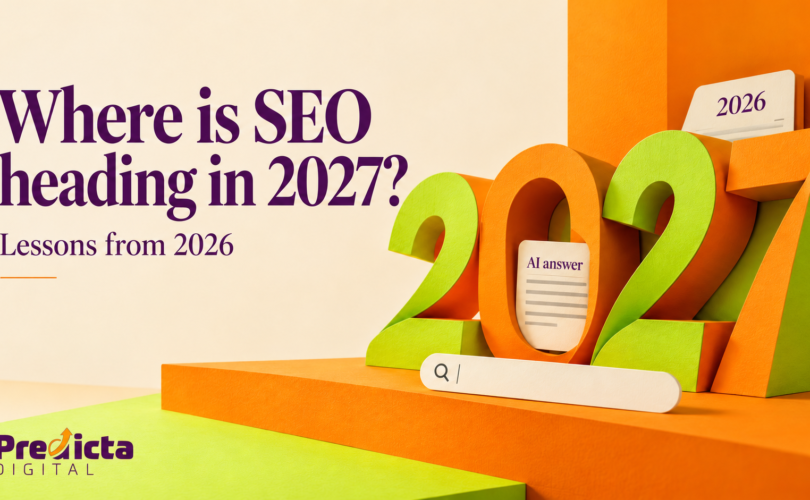

Where Is SEO Heading in 2027
In 2026, one of our ecommerce clients had fairly steady Google rankings while its ChatGPT citations and AI referral traffic were falling. The cause turned out to be a firewall introduced during a hosting migration. Genuine OpenAI requests were being blocked.
The rankings report had captured only part of what was happening. We needed server logs to understand the access problem, and we still needed sales data to establish what the recovery was worth.
That experience has shaped how I am approaching SEO in 2027. Customers can encounter and evaluate a business through several search experiences. A keyword position alone tells me less about that journey than it used to. An SEO review needs to examine whether the business can be found, whether its information is accurate and whether the resulting visits contribute to sales or qualified enquiries.
The research published during 2026 helps explain the direction. My recommendations for 2027 draw on that evidence and my client work so far. They are priorities to test and review as behaviour develops.
What 2026 showed and what I would prioritise in 2027
Some of these issues have been part of SEO for years. What changed in 2026 was the need to assess them across conventional search and AI assisted discovery at the same time.
| Area | What 2026 showed | My priority for 2027 |
|---|---|---|
| Search behaviour | Shoppers used AI alongside search, and our enquiries increasingly mentioned ChatGPT citations. | Assess buying questions and the sources used to recommend businesses. |
| Technical SEO | In our client work, Google rankings looked steady while a firewall blocked AI access. | Include relevant crawler access in audits and migration checks. |
| Review evidence | Our captured ChatGPT runs checked third-party reviews without reading Google Maps or Business Profile pages. | Build genuine reviews on relevant platforms alongside Google. |
| Content | Our reviews still found errors in existing pages and internal links. | Improve commercially important pages and verify their evidence. |
| AI workflows | Gartner found marketing leaders allocated 15.3% of budgets to AI, but only 30% reported mature AI readiness. | Measure time saved, review effort and accuracy before expanding an AI workflow. |
| Product discovery | YouGov found 45% of likely Australian holiday shoppers were comfortable with AI price comparisons; 10% with purchases made without asking. | Keep product prices, stock, delivery and returns information accurate across pages and feeds. |
| Reporting | Ranking tables missed access failures and the wider business result. | Lead with qualified enquiries, sales, revenue and profitability. |

SEO needs to account for how customers use Google and AI together
The clearest change is the number of places that can influence a buying decision.
IAB Australia and Pureprofile’s July 2026 report found that 54% of surveyed Australian online shoppers had used an AI assistant to discover, research or compare products and brands. In the same survey, 92% used search engines for those activities. The sample covered 1,079 online shoppers aged 18–70. 1
I am seeing the same shift in our lead-form enquiries. More prospective clients are asking about being cited by ChatGPT and improving AI visibility. I expect those questions to become more common in 2027 as businesses look beyond Google rankings to understand where customers find and assess them.
Those figures describe overlapping habits. Someone might ask an assistant for options, check a retailer’s website, read reviews and return through Google. That example is an illustration of how channels can interact; the survey does not tell us that everyone follows that sequence.
For 2027, I would review the questions that influence a purchase alongside the keywords that currently generate visits. Are product specifications current? Do service pages explain who the service suits? Are business details and reviews consistent with what the website says?
Keep Google Search Console trends and landing page performance in the review. Add a consistent sample of relevant AI queries, recording the date, platform and sources surfaced. Treat that sample as a diagnostic view; it cannot establish visibility across every answer a system might generate.
SEO, generative engine optimisation and answer engine optimisation overlap here. Our guide to SEO, GEO and AEO explains the terminology. The practical task is to make the business discoverable and accurately represented where its customers look.
Technical SEO is the foundation for search and AI visibility
Google’s John Mueller recently reinforced a point that matters for 2027: AI systems build on SEO, and technical SEO remains very relevant. In his interview with David Iwanow, he explained that different crawling purposes, such as training and retrieving fresh information, extend the technical work we already do. 2
For me, that makes technical SEO a foundation for both conventional search and AI visibility. Google’s own guidance says the existing SEO fundamentals apply to AI Overviews and AI Mode. A supporting page must be indexed and eligible to appear in Search with a snippet; there is no separate technical shortcut into those features. 3
The practical work includes checking crawl access, response codes, redirects, canonical URLs, indexing controls and internal links. Important information needs to be available in a form the relevant system can retrieve. I also want to understand what happens when a crawler encounters JavaScript, a login requirement or a security challenge.
Google indexing checks alone do not establish that other systems can access the same pages. For 2027, I would include relevant AI crawler and fetcher access in routine audits, hosting migrations and firewall reviews. Verify who is making the request and inspect the actual response before changing security settings.
Our work as an AI SEO agency in Melbourne includes these checks alongside conventional search analysis. Better content needs functioning access before it can become useful evidence for a search or AI system. Access creates the opportunity; it does not guarantee a citation.
Entity validation and third party reviews will matter more in 2027
Using my app, Retrieval Studio, I reviewed seven batches of ChatGPT runs between September and November 2026, testing the same set of prompts in the same business niche. The detailed page-reading analysis covers 51 runs with complete retrieval capture, from two batches on 9 October and batches on 22 October, 28 October and 5 November.
Across those 51 runs, I did not see ChatGPT retrieve a single Google Maps or Business Profile page containing Google reviews. Instead, it searched third-party review sites such as Trustpilot and Clutch.
Clutch was the most frequently checked review platform, with up to ten site:clutch.co searches in a batch. Trustpilot was cited in all three brand checks on 9 October and all three on 28 October; on 28 October, it was the only independent review source cited.
The relevant platform depends on the business niche. ProductReview may be more relevant for some consumer businesses, while Clutch suits agencies and other service providers. I would choose platforms based on where genuine customers leave useful evidence and which sources appear in relevant AI answers.
Google reviews are still valuable for visibility and customer confidence on Google Search and Maps. Google itself says more reviews and positive ratings can help local rankings. 4 But I would encourage clients to build genuine reviews on other relevant platforms too, particularly where reviews are published on pages that LLMs can retrieve.
What stood out in my research was the way ChatGPT checked the business against outside sources. Our own testimonials and case studies explained what we claimed to have achieved; independent reviews gave it another way to assess those claims. When client reviews were limited, employee review sites sometimes filled the gap: Glassdoor was cited in all three ChatGPT brand checks on 9 October, while AmbitionBox appeared in a Google AI Overview for “predicta digital reviews”. Business replies also became part of the evidence it considered.
I expect entity validation to become a bigger part of SEO and GEO in 2027. That means helping systems establish who a business is, what it does and whether credible sources support its reputation. Consistent business information, detailed case studies and genuine customer reviews across relevant platforms all contribute to that picture.
For clients, I would start with the platforms their customers already use and the sources appearing in relevant AI answers. Build an accurate presence there and ask customers for honest feedback. The aim is to give prospective customers and AI systems useful evidence they can find and assess.
Will SEOs obsess less about Reddit in 2027?
Reddit’s own experience raises a question about how much attention SEOs should give the platform. In its latest shareholder update, Reddit reported a meaningful decline in search referrals. Its CEO pointed to Google’s AI Overviews and AI Mode as likely contributors, alongside changes affecting translated content. 5
My research gives me another reason to question the assumption that Reddit activity automatically translates into AI visibility. Across the results I reviewed, Reddit was retrieved 129 times and cited zero times in the final answers.
ChatGPT accessed those pages, yet none appeared as a cited source in the answers I reviewed. That finding relates to the queries I tested, so I would keep checking how it changes across topics and business categories.
For 2027, I would assess Reddit against what it contributes to the business. Are relevant customers having useful conversations there? Are those discussions influencing enquiries, referrals or how people understand the brand? Participation can have value where those connections exist. I would be much more cautious about treating Reddit posting as a dependable route to ChatGPT citations.
Content plans need to include maintenance and evidence
Publishing more pages can make an existing content problem harder to manage.
During a recent client review, I found nine incorrect internal links across three pages. The links used the wrong version of the business’s domain. The required fix was straightforward: correct the domain while preserving the intended destination and anchor text.
That finding did not explain every performance issue on the site, and I would not claim a ranking improvement from the correction without measuring it. It did show why routine inspection belongs in a content programme.
For 2027, I would reserve time for reviewing important existing pages before commissioning another large batch. A content audit should assess what remains useful, what needs current evidence, which pages overlap and where navigation or links fail.
The strongest additions often come from information the business already holds. Explain how a specification affects a purchasing decision. Show a dated example of a problem and its resolution. Clarify what a quoted service includes and where its limitations sit.
AI can help organise that material and prepare drafts. Someone with the relevant knowledge still needs to verify the claims. A page with a recent date and unchanged advice has not become more useful simply because it looks current.
AI should improve the quality and efficiency of SEO work
Gartner’s May 2026 CMO Spend Survey found that respondents allocated an average 15.3% of marketing budgets to AI initiatives, while only 30% reported mature or fully developed AI readiness. The survey covered 401 marketing leaders in North America, the UK and Europe, mostly at businesses with more than US$1 billion in annual revenue. These are enterprise findings, rather than an Australian small business budget benchmark. 6
For an SEO team, the useful question is what improves after a tool enters the workflow. Buying access does not establish how it will improve the work.
In my own audit workflows, AI can help examine exports and organise findings. I still need to establish whether the evidence supports the recommendation and whether it matters for that client. An output that takes longer to check than it saves in preparation has a real cost.
For 2027, I would choose one recurring task and measure the whole process. Record preparation time, review time, corrections and the quality of the final result. Check whether another person can reproduce a finding from the evidence provided. Give the process an owner and specify when human judgement is required.
Reliable workflows should give the team more capacity to investigate problems and make decisions. A longer audit does not establish that the work is better. Recommendations still need priorities, owners and a way to assess the result.
Product information matters as AI assists buying decisions
AI assistance with research is already relevant to marketing. Delegating the purchase raises additional questions about permission, price and accountability.
YouGov’s October 2026 Australian Black Friday and Cyber Monday summary found that 45% of likely shoppers were comfortable using AI to find the best price. Only 10% were comfortable letting it complete a purchase without asking first. The public summary does not disclose its sample or fieldwork dates, so I would treat this as a directional finding about holiday shopping attitudes. 7
For 2027, comparison and shortlisting look like practical areas to prepare for. Businesses can improve the information an assistant or customer needs now: current prices, availability, product attributes, delivery charges and returns conditions.
Autonomous purchasing may become useful in particular settings, especially where the customer has clear preferences and repeat requirements. These survey results cannot tell us how quickly that will happen.
Check whether product pages and feeds agree on price, availability and important attributes. Before funding an integration, establish who would use it and what problem it would solve. A product feed that accurately reflects stock and pricing can support current buying journeys while leaving the business better prepared for future developments.
SEO reporting needs to connect visibility with commercial performance
I have already removed keyword ranking tables from my client reports. For years, too much of the SEO conversation revolved around whether a keyword moved from position eight to position five. That movement needs commercial context before it tells a business owner anything useful.
Google’s /goto URLs have added another complication to third-party search data collection. SerpApi documented problems resolving destination URLs, a September fix and further incidents later in the year. Its September explanation said the issue affected destination links rather than the ranking positions themselves. Providers have adapted, but the disruption is a reminder to check how a tool collects and resolves results before treating a reported change as a real change in performance. 8
The page itself has changed too. AI Overviews and sponsored placements can push conventional organic listings further down. Google confirms ads can appear above or below an AI Overview, as well as within supported AI experiences. The layout varies, so an organic position does not describe the whole screen a customer sees. 9
I still use search data to investigate problems and opportunities. I do not use a ranking table as the main verdict on whether the work is paying off.
For 2027, the main measures in my client reporting will be commercial KPIs: qualified enquiries, booked consultations, sales, revenue and the contribution remaining after costs. For a service business, I want to connect enquiries with actual opportunities and won work. For an ecommerce business, I want to understand orders, conversion rate and profitability alongside acquisition costs. The exact measures depend on the business and the data available.
With one BigCommerce client, Google Search Console clicks rose from 2,991 in April 2026 to 4,066 in July. Across the same period, BigCommerce recorded organic search revenue increasing from approximately A$40,292 to A$68,051.
July’s monthly comparison needed closer attention. Organic revenue increased 11.4% compared with June, while total store revenue fell 24.6%. A report showing only the organic result would have missed the wider commercial problem. We needed to examine the other channels and store performance before recommending the next investment.
AI referrals deserve the same discipline. Adobe reported that, in September 2026, AI referred visits to US retailers generated 83% higher revenue per visit than other traffic. Differences in customer intent may help explain that comparison. It does not establish that AI caused the improvement or predict an Australian store’s return. 10
For the client whose firewall we investigated, subsequent reporting showed more than 800 ChatGPT referrals over 90 days, with visits reaching product pages and checkout. That is encouraging, although checkout activity does not establish a completed sale. The next questions concern completed orders, the contribution those orders make after costs and whether the return justifies the work.
Review what happens after a search visit too. A store should make delivery costs and conditions clear before the final checkout step. A service business should check whether its enquiry form works and whether someone responds appropriately. Acquisition reports cannot explain those problems on their own.
In 2027, I would keep identifiable AI referrals separate from customers who report AI influence. Check for overlap before adding results together. Wider organic and direct movements provide context, but an unexplained increase in direct traffic should not automatically be credited to AI.
My guide to measuring AI search ROI covers this process in more detail. Reliable marketing analytics should help decide whether to continue, adjust or reduce an activity.
Where I would start with SEO in 2027
I would start with the business’s commercial priorities and the problems already visible in its data. Check measurement and enquiry handling. Review the pages that influence purchases, including their links and technical accessibility. Check the independent sources customers and AI systems use to evaluate the business. Then test a specific improvement in search coverage or an AI workflow against a defined outcome.
The work I have described from 2026 involved investigating access failures, maintaining existing content and interpreting results that moved in different directions. Those responsibilities continue as customers use more search experiences.
For 2027, I want an SEO plan that leaves room to learn while making each investment decision clearer. The business should understand what we observed, what changed after the work and what still needs investigation.
For practical support with your search priorities, explore SEO services Melbourne from Predicta Digital.
Research note: These findings describe a sample of observed ChatGPT runs, not a controlled experiment or every response the system might produce. The client performance figures are drawn from my own reporting and have not been independently audited.
Sources
1. IAB Australia and Pureprofile, Commerce and Discovery Report 2026, 6 July 2026. Australian online shoppers aged 18–70, n=1,079; discovery pp27 and 33. Read source
2. John Mueller interview with David Iwanow, Search Central Deep Dive Europe 2026, published 29 October 2026. Technical SEO discussion. Read source
3. Google Search Central, AI features and your website, checked 6 November 2026. Read source
4. Google Business Profile Help, Tips to improve your local ranking on Google, checked 6 November 2026. Read source
5. Reddit, Q3 2026 shareholder letter and earnings commentary. Search referral decline reported by Reddit; AI Overviews and AI Mode identified by its CEO as a working explanation. Read source
6. Gartner, 2026 CMO Spend Survey release, 11 May 2026. Read source
7. YouGov, The bots and the basket, 15 October 2026. Public summary of Australian Black Friday and Cyber Monday shopping intentions and attitudes. Read source
8. SerpApi, We Have Resolved the Google /goto URL Redirect Rollout, 5 September 2026. Subsequent incidents checked against the provider’s status history on 6 November 2026. Read source
9. Google Ads Help, About ads in AI-powered experiences in Google Search, checked 6 November 2026. Read source
10. Adobe Digital Insights, AI traffic and US retail performance, 29 October 2026, reporting September 2026 results. Read source
Service incident history for the /goto discussion: https://status.serpapi.com/
Reddit CEO’s earnings-call explanation, reported by Search Engine Journal: https://www.searchenginejournal.com/reddit-to-test-login-only-mode-as-google-search-traffic-drops/595270/