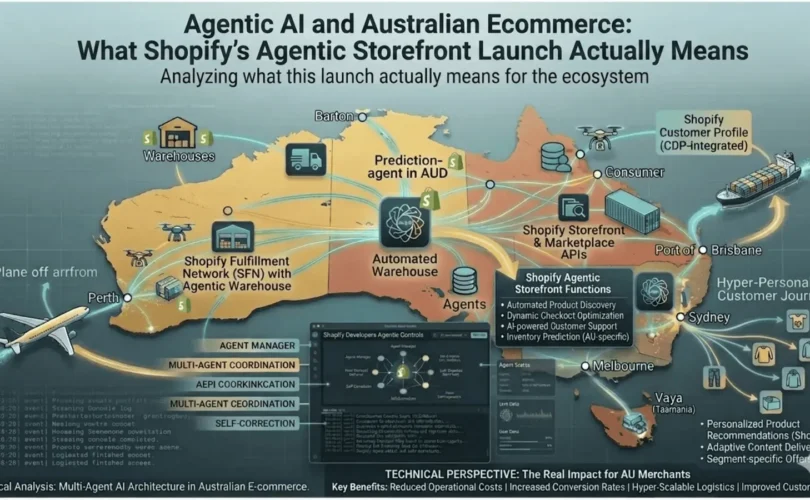

Agentic AI and Australian Ecommerce: What Shopify’s Agentic Storefront Launch Actually Means
Shopify merchants in Australia are missing sales right now. Not because their store is slow, or their ads have stopped working. Because their products aren’t showing up when shoppers ask ChatGPT, Google’s AI Mode, or Microsoft Copilot what to buy.
In March 2026, Shopify launched Agentic Storefronts as part of its Winter ‘26 Edition, and as of May 2026 the feature is live for eligible stores globally. It automatically makes products from connected Shopify stores available to AI shopping agents across ChatGPT, Google AI Mode, Gemini, and Bing Copilot. Merchants manage it from the Agentic section of their admin, toggling individual channels on or off without a separate integration.
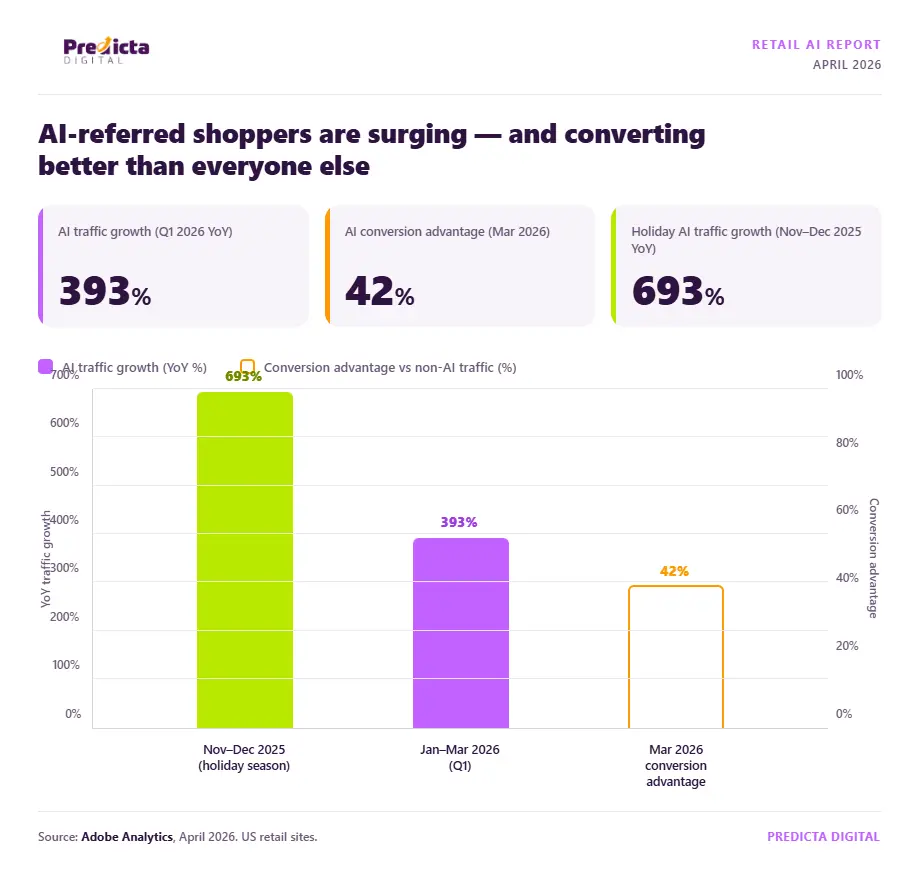
The problem is that ‘automatically’ has conditions attached. Shopify’s own agentic commerce data shows AI-driven traffic to merchant stores has grown 8 times year on year, with orders from AI referrals growing 15 times. Adobe Analytics data shows AI-driven traffic to retail sites grew 393% year on year in Q1 2026, converting 42% better than non-AI traffic. Most stores are not visible in that channel, and most don’t know it. That figure comes from a vendor with a commercial interest in the problem, but the underlying technical barriers are independently verifiable. The Agentic Storefront launch changes what’s possible. It doesn’t fix the setup issues preventing products from appearing.
What Shopify’s Agentic Storefront Does
Products showing up inside ChatGPT when someone asks what to buy, without a paid campaign behind them, is what the Agentic Storefront makes possible. Shopify is one of the few platforms with a direct data feed into the AI shopping layer, and merchants who meet the technical requirements get pulled into AI results on relevance alone.
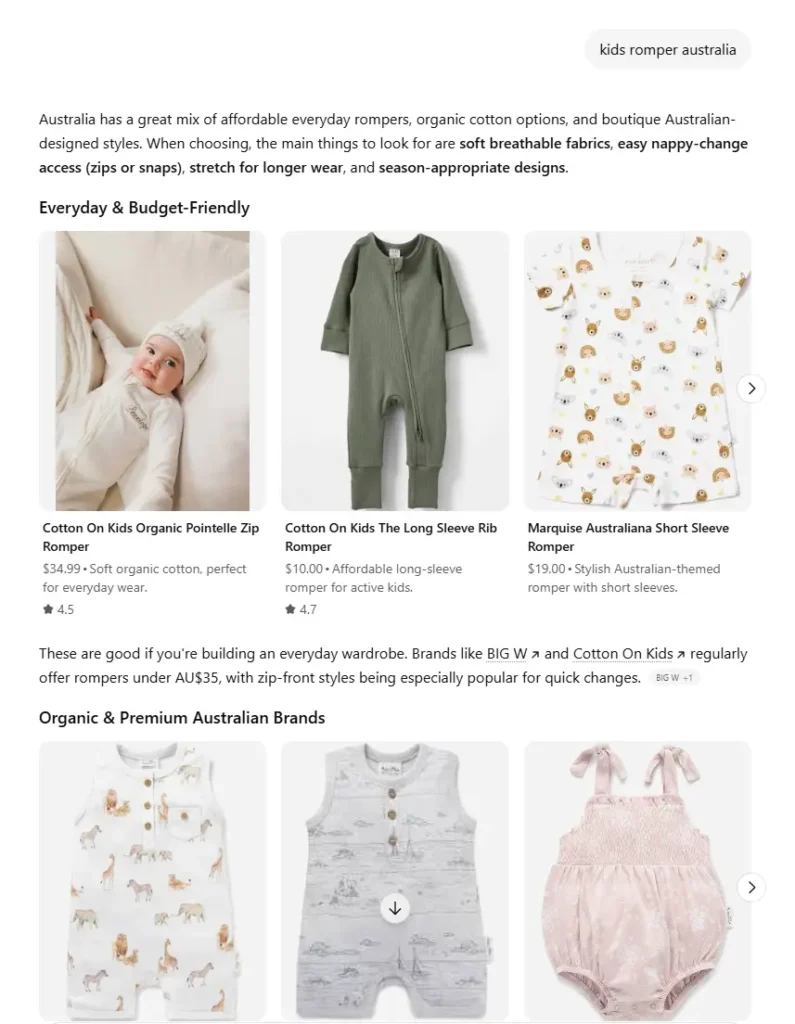
When a shopper types ‘best merino wool socks under $40’ or ‘running shoes with wide toe box’ into ChatGPT or Google AI Mode, the AI no longer returns a list of links. It retrieves and presents actual products, with pricing and availability, from connected stores. Shopify Catalog structures the product data. AI-sourced orders flow into the standard admin with full channel attribution.
For Google and Microsoft channels, no fees apply: products surface because the store is correctly structured and the AI judges them relevant. ChatGPT’s commercial terms are still being finalised. Either way, it is closer to organic search than paid media, which means the merchants who sort the technical setup early hold a positioning advantage while competitors are still deciding whether the channel matters.
What Australian Merchants Need to Know About Eligibility
Most guides written for Australian audiences skip this section entirely. It is the most important part.
Shopify’s Agentic Storefronts are not fully available to stores that sell exclusively to Australian customers. Shopify’s eligibility requirements break down by channel as of May 2026:
| Channel | Store location requirement | Customer location requirement | Status (May 2026) |
| ChatGPT | Any country (incl. Australia) | Must sell to US buyers | Live for eligible stores |
| Microsoft Copilot | Any country (incl. Australia) | Must sell to US buyers | Live for eligible stores |
| Google AI Mode / Gemini | US-based stores only | US buyers only | Early access — not all stores |
| Perplexity | Any country | No restriction stated | Via Shopify Catalog toggle |
An Australian store that ships exclusively within Australia currently sits outside the direct checkout layer for ChatGPT and Copilot, and outside the Google AI Mode and Gemini integration entirely. A store that sells internationally, including to US customers, can participate in ChatGPT and Copilot discovery regardless of where the store is based.
Australian-only stores still have meaningful options. AI platforms can surface products through correctly structured data, crawlable pages, and open crawler access, even without the checkout layer. The Agentic Storefront checkout is the restricted part, not AI search visibility generally. Getting the technical foundations right now means those stores benefit immediately when geographic restrictions expand.
Not sure whether your store qualifies or what channels your products currently appear in? Our free SEO audit includes an AI visibility check: which platforms can crawl your store, where the blocks are, and what to fix first.
Why Most Shopify Stores Aren’t Benefiting Yet
Three technical issues account for most stores being invisible to AI shopping agents.
AI crawlers can’t read the products
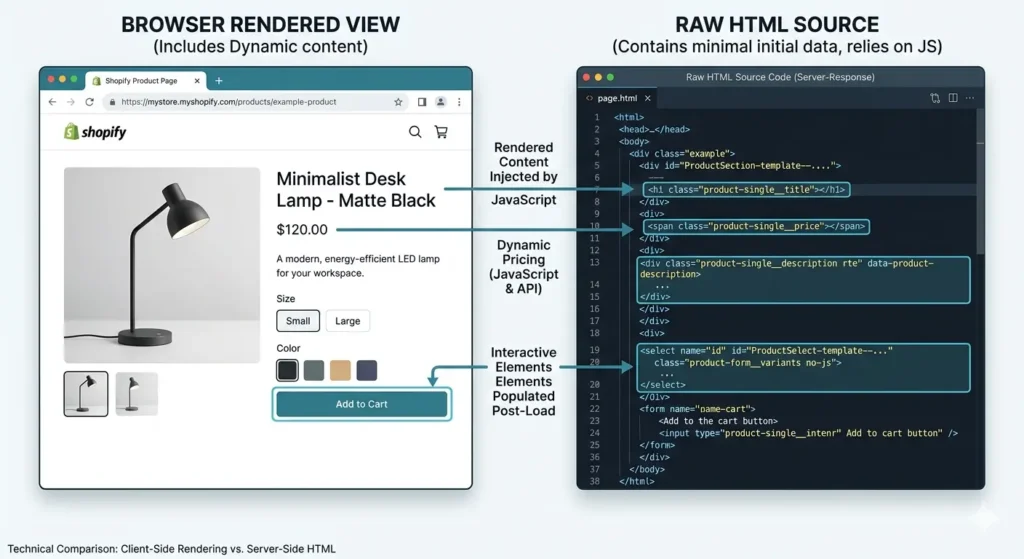
AI systems like GPTBot and ClaudeBot don’t execute JavaScript the way a browser does. Many Shopify themes render product data client-side, so when an AI crawler visits, it sees an empty container rather than product names, descriptions, prices, and specifications.
The crawler leaves. The products don’t appear.
This is a rendering problem, not a content problem. The products exist. The AI just can’t see them.
The store is blocking AI crawlers entirely
Between 2023 and 2025, a wave of security and SEO plugins added ‘block AI bots’ toggles, and many turned them on by default. Merchants who updated plugins during this period may have cut off OAI-SearchBot (which sources products for ChatGPT) and PerplexityBot without knowing it.
The key distinction: AI training crawlers scrape content for model training with no traffic benefit to the merchant. AI search crawlers retrieve product data to surface in shopping results and send buying intent directly to the store. Blocking all AI bots blocks both. The correct configuration allows search crawlers while optionally restricting training crawlers.
The pattern I keep seeing: the block isn’t in robots.txt. It’s one layer up, in Cloudflare, where a plugin update quietly switched on AI crawler blocking without a notification. The store looks open. The crawlers can’t get in. A store can have a perfectly configured robots.txt and still be completely blocked at the CDN level.
Product data isn’t structured for AI retrieval
AI shopping agents pull product data from structured sources: schema markup, product feeds, and detailed descriptions. Stores without Product schema, or with vague and truncated descriptions, rarely surface when the AI is choosing what to recommend.
Specificity matters. Dimensions, materials, compatibility, and use cases are the fields that let AI agents match a product to a conversational query. ‘Blue sneaker’ loses to ‘wide-toe-box trail running shoe, size 9–14, zero drop, 4mm lug depth’.
If your store has any of these issues, the fixes are technical, not a redesign. Our SEO services cover rendering configuration, robots.txt corrections, CDN settings, Product schema, and Knowledge Base setup.
What This Means for AI Search Visibility Strategy
A shopper asking ChatGPT what to buy has already decided to buy. That is a different intent level from organic search, where the same shopper is still deciding. Products appearing in AI shopping results are positioned at the end of the consideration stage, not the beginning.
Direct checkout inside the AI interface removes the store from the transaction. No branded checkout experience, no upsell sequence, no email capture, no on-site session data. For stores that invest in post-purchase journeys and customer lifetime value, that matters. ChatGPT currently redirects buyers to the store’s own checkout, so the conversion experience is preserved for that channel. The direct checkout model applies to Copilot and Google AI Mode for eligible stores.
Shopify AI-driven orders have grown 15 times. Stores that currently block or hide from AI systems are missing an AI SEO channel that is already driving revenue for competitors.The fixes are technical rather than requiring a content rebuild: rendering configuration, robots.txt corrections, CDN settings, and structured data are all addressable without redesigning a store.
AI Shopping Agent Access: What Each Platform Needs
| Platform | Crawler to allow | Key requirement | Checkout model |
| ChatGPT / OpenAI | OAI-SearchBot, GPTBot | Products in Shopify Catalog; sells to US buyers | Redirects to store checkout. Conversion experience preserved. |
| Google AI Mode / Gemini | Googlebot, Google-Extended | US-based store and US buyers; Product schema; Google Merchant Centre feed | Direct checkout inside AI (US only; early access) |
| Microsoft Copilot | Bingbot | Sells to US buyers; toggle active in Shopify admin | Direct checkout inside AI |
| Perplexity | PerplexityBot | Toggle active in Shopify admin via Agentic section; crawlable product pages; detailed descriptions | Discovery referral; redirects to store |
What to Check on Your Shopify Store This Week
Six checks that cover the most common reasons Australian stores are invisible to AI shopping agents.
- Check robots.txt at yourdomain.com.au/robots.txt for any Disallow rules referencing OAI-SearchBot, GPTBot, ClaudeBot, or PerplexityBot. If those crawlers are disallowed, the products won’t appear in their respective platforms.
- Check Cloudflare bot management settings if the store runs through Cloudflare. Under Security > Bots, confirm AI search crawlers are not blocked at the CDN level. This is separate from robots.txt and overrides it.
- Test product pages for AI readability by viewing the page source without JavaScript rendering. If product names, prices, and descriptions aren’t visible in the raw HTML, AI crawlers can’t read them.
- Review Product schema in Google Search Console under Rich Results, or using Google’s Rich Results Test. Missing or incomplete Product schema reduces the likelihood of AI agents selecting products for shopping queries.
- Set up the Shopify Knowledge Base app from the Shopify admin. This controls what AI platforms say about the brand: product descriptions, brand story, policies, and tone. It feeds directly into the AI responses that reference the store and takes less than an hour to configure.
- Check eligibility for each channel in the Agentic section of the Shopify admin. If the store sells internationally or to US customers, confirm the relevant channels are toggled on. If it sells exclusively within Australia, focus on product data quality and crawler access: these foundations apply regardless of current channel eligibility.
The window for early advantage is real. The stores configuring this correctly while most competitors haven’t noticed the channel will hold a citation advantage that compounds. Our Shopify SEO services cover the full technical setup, and our ecommerce SEO services extend the same approach across WooCommerce and other platforms.
Frequently Asked Questions
Shopify’s Agentic Storefront is a system that makes eligible merchant products available to AI shopping agents, including those inside ChatGPT, Google AI Mode, Gemini, and Microsoft Copilot. It launched in March 2026 as part of Shopify’s Winter ‘26 Edition. Merchants manage it from the Agentic section of the Shopify admin, toggling individual AI channels on or off while Shopify handles the product feed and protocol work.
Partially. Australian stores can participate in ChatGPT and Microsoft Copilot discovery if they sell to US customers. The store does not need to be US-based for those channels. Google AI Mode and Gemini direct checkout currently require both a US-based store and US customers. Stores selling exclusively within Australia are not yet eligible for the direct checkout layer, but can still appear in AI shopping discovery through correct product schema, structured data, and open crawler access.
No. The feature creates the pathway; the store still needs to meet technical requirements before products surface. Those include allowing the relevant AI crawlers, ensuring product pages are crawlable without JavaScript rendering, and having correct Product schema in place. Stores that have accidentally blocked AI crawlers through plugin settings or CDN configuration won’t benefit until those blocks are resolved.
View robots.txt at yourdomain.com.au/robots.txt and check for Disallow rules referencing OAI-SearchBot, GPTBot, or PerplexityBot. If the store runs Cloudflare, check bot management settings in the Cloudflare dashboard separately: CDN-level blocks override robots.txt. If a Shopify or SEO plugin was updated between 2023 and 2025, check whether a ‘block AI bots’ toggle was activated by default during the update.
The Knowledge Base app controls how your brand appears in AI conversations: brand story, product descriptions, policies, and tone. It feeds directly into the AI responses that reference your store. Without it, AI platforms piece together your brand narrative from whatever they can crawl. With it, you provide a verified, structured source that AI platforms use preferentially. Available to all merchants on Agentic Storefronts; takes less than an hour to configure.
No. AI search crawlers retrieve live product data to surface in shopping results and send buying traffic to your store. AI training crawlers scrape content to train language models with no traffic benefit. The correct configuration allows search crawlers (OAI-SearchBot, PerplexityBot, Bingbot, Googlebot) and optionally restricts training crawlers. Blanket blocking removes products from AI shopping discovery entirely.
The Agentic Storefront integration is specific to Shopify’s commercial partnerships with OpenAI, Google, and Microsoft. WooCommerce and other platforms can still appear in AI shopping results through correctly structured Product schema, crawlable product pages, and open AI crawler access. Our ecommerce SEO services cover the same technical foundations across non-Shopify platforms.
In a direct checkout transaction, where the purchase completes inside the AI interface, the shopper never reaches the store. That means no branded checkout experience, no upsell sequences, and no email capture at checkout. ChatGPT currently redirects buyers to the store’s own checkout, preserving that experience for that channel. The direct checkout model applies to Copilot and Google AI Mode for eligible stores.
The stores that will win in AI shopping discovery over the next 18 months are the ones whose product data is structured correctly, whose crawlers are configured deliberately, and whose brand narrative is controlled rather than inferred. If you want to know where your store stands right now, start with our Shopify SEO services.