
How to Rank in Google Local Search in 2026
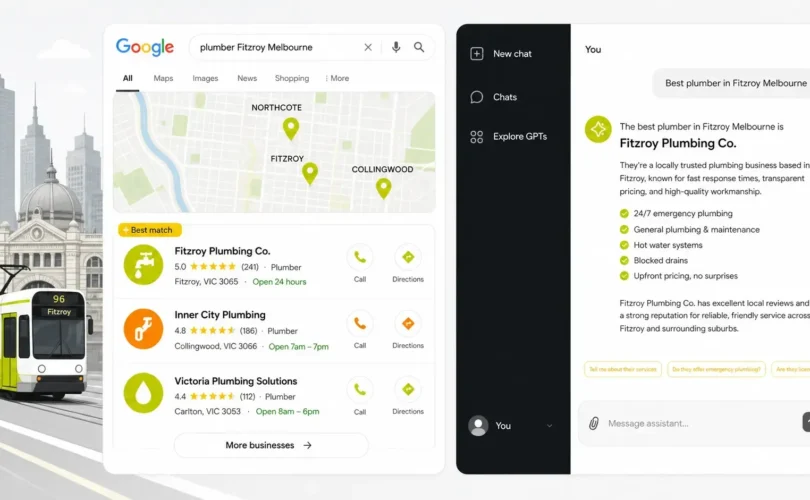
Most local SEO advice treats the Map Pack as the finish line. In 2026, it is half the race. 42% of local searches still click a Map Pack result (Backlinko, 2024) — that number has not changed much in years. What has changed is what happens before the Map Pack. 45% of Australian consumers now use ChatGPT or other AI tools for local business recommendations, up from just 6% twelve months ago (BrightLocal, 2026). The Melbourne business that only optimises for Google Maps is now invisible to almost half its potential customers before they ever open a search results page.
Local visibility in 2026 runs on two parallel tracks: the Map Pack and AI search. The good news is that the fundamentals that build one mostly build the other. The important nuance is that the weighting differs, and knowing which factors matter where is what separates businesses that appear everywhere from businesses that appear nowhere. This is what SEO services in Melbourne look like in practice right now.
How Google Ranks Local Results: The Three Signals That Actually Matter
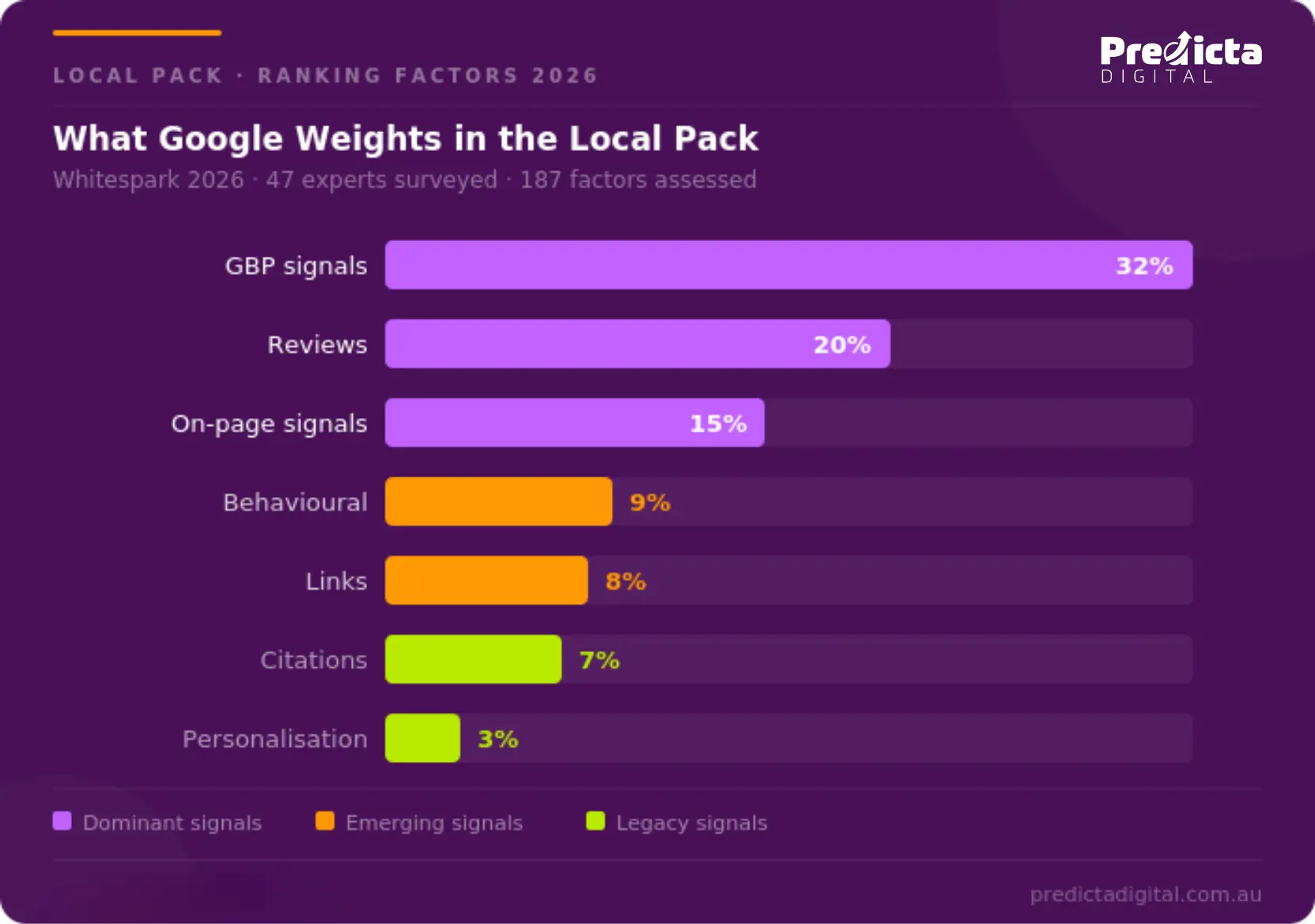
Before optimising anything, it helps to understand what Google is actually measuring. Whitespark’s 2026 Local Search Ranking Factors report — the industry’s most cited annual research, surveying 47 local SEO experts across 187 factors — breaks local pack rankings into five categories. Three of them account for the majority of ranking influence:
- GBP signals: 32% of local pack ranking weight — the single largest category. Your primary GBP category is the top individual ranking factor.
- Review signals: 20% — up from 16% in 2023. Review recency is now the leading individual review factor, ahead of volume.
- On-page signals: 15% — local content and suburb-level keyword targeting on your website. Jumps to 24% for AI search visibility.
The remaining weight is split between behavioural signals (9%), link signals (8%), citation signals (7%), and personalisation (3%). Citations — your NAP data across directories — have dropped sharply, from 13% of ranking influence in 2020 to 7% in 2026 per Whitespark’s data. They still matter as a trust foundation, but the days of building 50 directory listings as a primary local SEO strategy are over.
One factor that does not move rankings despite being widely recommended: GBP posts. A Sterling Sky controlled study tracking 441 keywords across a 9-week period found zero ranking movement from regular GBP posting. Posts have engagement value — they give searchers reasons to click — but they are not a ranking signal. Focus your GBP effort on the factors that are.
Google Business Profile: The Highest-Impact Work You Can Do Today
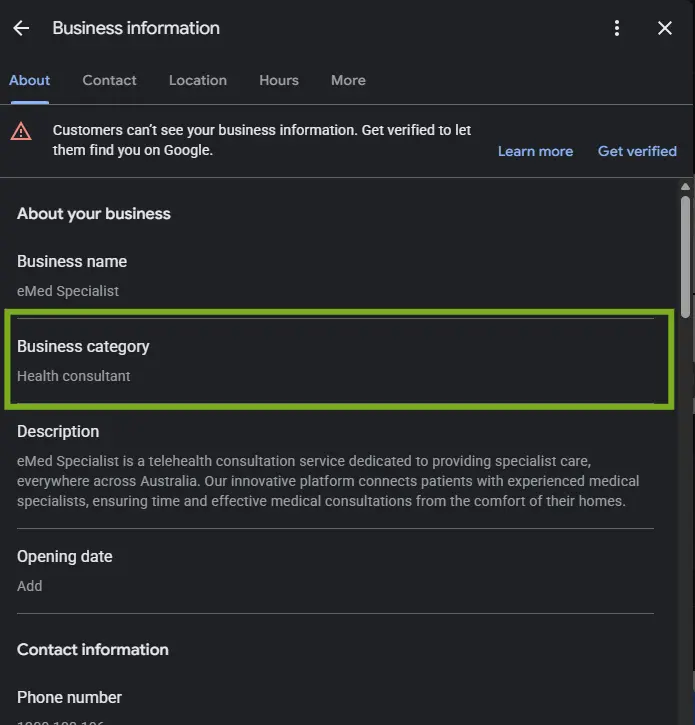
GBP optimisation is the single highest-return activity in local SEO — not because it is particularly complex, but because most Melbourne businesses leave significant gaps that are straightforward to fix. Your primary GBP category is the top individual local pack ranking factor according to Whitespark’s 2026 data. Getting it wrong — or leaving it as a generic category when a more specific one exists — suppresses your visibility across every search variant.
The factors that move Map Pack rankings within GBP:
- Primary category: choose the most specific category that accurately describes your core service. For a plumber who also does gas fitting, “Plumber” outperforms “Gas Installation Service” for most searches — but a business with two distinct services can benefit from secondary categories.
- Business hours accuracy: being open at the time of search is the #5 individual ranking factor in Whitespark’s 2026 survey — confirmed independently by a BrightLocal study of 50 businesses across 10 categories that found rankings dropped when profiles showed as closed. Your hours are a ranking signal, not just informational.
- Profile completeness: services, products, descriptions, and attributes filled with relevant detail. The profile should describe exactly what you do and where, using the language your customers actually search for.
- Photos: recent, high-quality images of your business, team, and work. Frequency matters — a profile updated fortnightly with genuine photos performs better than one with a batch upload from 2022.
- Website link: link your GBP to a suburb-specific landing page, not your homepage. Whitespark’s 2026 data shows this connection between a localised page and your GBP profile as a meaningful on-page signal.
One practical note specific to Melbourne: Google can and does make automatic changes to your GBP based on third-party data, and the public can suggest edits that Google sometimes accepts without notifying you. Check your profile at least fortnightly. A wrong phone number or updated hours you did not set can send customers straight to a competitor.
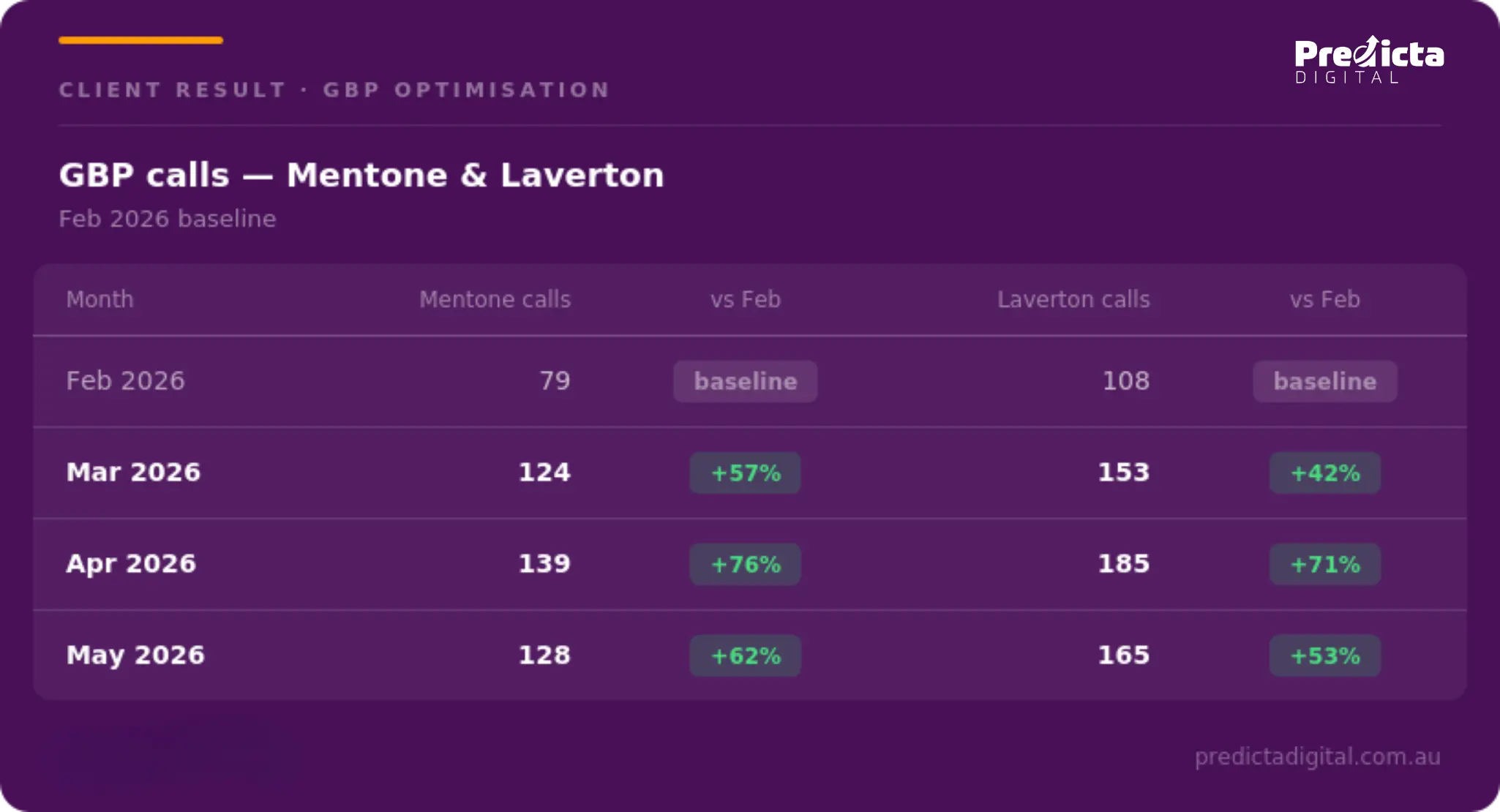
What GBP optimisation actually produces — two Melbourne examples
A smash repair business with two Melbourne locations — Mentone and Laverton — saw GBP calls increase from a February 2026 baseline of 79 (Mentone) and 108 (Laverton) to peak monthly figures of 139 and 185 respectively by April 2026. That is a 76% increase in calls from the GBP listing alone at the Mentone location and 71% at Laverton, with no increase in ad spend. The work: category refinement, photo refresh, consistent weekly profile updates, and a structured review response strategy.
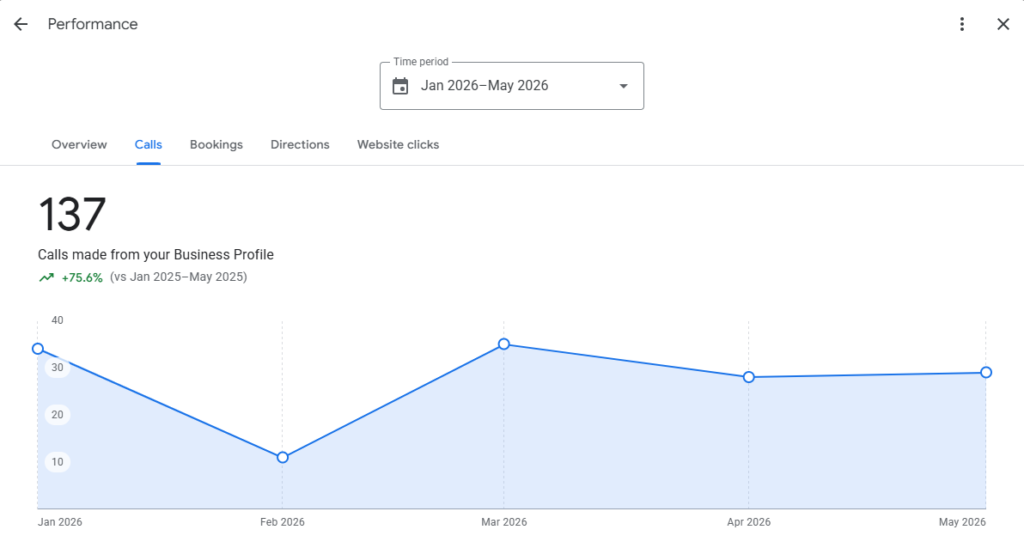
A local tiling business in Melbourne recorded 137 calls from its Google Business Profile between January and May 2026 — a 75.6% increase on the same five-month period in 2025. Again, no paid media. The driver was GBP completeness and review velocity: the profile went from sparse to fully built out, and new reviews were coming in consistently rather than in occasional bursts.
Both results came from the same set of actions: correct primary category, complete profile information, fresh photos, consistent NAP, and a steady review cadence. No shortcuts, no new ad budget.
Reviews: The Ranking Factor Growing Fastest in 2026
Review signals grew from 16% to 20% of local pack ranking weight between 2023 and 2026 — the fastest-moving factor in Whitespark’s data. The mechanism matters here: it is not just the number of reviews driving rankings, it is the pattern of reviews. A steady weekly flow of genuine reviews signals active engagement to Google’s algorithm far more effectively than a burst of ten reviews followed by three months of silence.
The consumer behaviour data reinforces why this matters commercially, not just algorithmically. BrightLocal’s 2026 Local Consumer Review Survey found that 97% of consumers read reviews before choosing a local business, 41% always read reviews when browsing (up from 29% in 2025), and 68% will only consider businesses with four stars or higher. Businesses with 50 or more Google reviews are 266% more likely to appear in the Local Pack than businesses with fewer than ten (Whitespark, 2026).
What actually moves the review ranking signal:
- Velocity: consistent new reviews over time, not volume in a single burst
- Recency: reviews from the last 30 to 90 days carry more weight than an older five-star average
- Response rate: businesses that respond to 80% or more of reviews see measurable ranking improvement. Keywords in your responses matter — Google indexes business response text as a relevance signal. Sterling Sky’s controlled research found keywords in the customer review text itself have no ranking impact, but your response text does.
- Rating threshold: 4.0 stars is the floor; 4.5 to 4.9 is the sweet spot for both rankings and conversion
On-Page Local SEO: What Your Website Needs to Do
On-page signals account for 15% of local pack ranking weight — third-highest behind GBP and reviews. The work here is not complicated, but it requires suburb-level specificity that most Melbourne business websites do not have. A generic “Melbourne” service page that covers the whole city ranks for very little. A dedicated page for each suburb you actively operate in, built around the queries customers in that suburb actually use, ranks for the specific searches that produce enquiries.
The on-page elements that carry local ranking weight:
- Title tags and H1: your primary keyword plus suburb name, e.g. “Plumber in Richmond Melbourne” — not “Our Services”. Include the suburb in the first 60 characters of the title tag.
- NAP consistency: your Name, Address, and Phone number should appear on-page exactly as they appear in your GBP. Any discrepancy — different phone format, abbreviated street name — creates a trust conflict Google reads as uncertainty.
- Suburb-level content: the page should discuss the suburb specifically — not just mention it as a keyword. Nearby landmarks, local conditions, the specific types of work done in that area. This is the entity density that drives both traditional rankings and AI citations.
- LocalBusiness schema: structured data that confirms your business type, address, service area, operating hours, and review data. This feeds both Google’s Knowledge Graph and the AI systems that pull from it. The full technical implementation is covered in our technical SEO guide.
- Internal linking: link your suburb pages to each other and to your main service page. Link your GBP to the specific suburb page, not your homepage.
For Melbourne businesses with multiple service areas, this means building a dedicated page for each suburb you actively operate in — not a single “we service all of Melbourne” paragraph. The western suburbs corridor (Footscray, Sunshine, Point Cook, Werribee) searches differently from the inner east (Richmond, Hawthorn, Kew). Pages built around each area’s specific search patterns outrank generic metropolitan pages consistently.
The New Track: AI Search Visibility
For the first time in its nearly 20-year history, Whitespark’s 2026 Local Search Ranking Factors report added AI Search Visibility as a formal ranking category. The reason: the signals that determine whether your business appears in a ChatGPT or Perplexity recommendation are measurably different from the signals that drive Map Pack rankings.
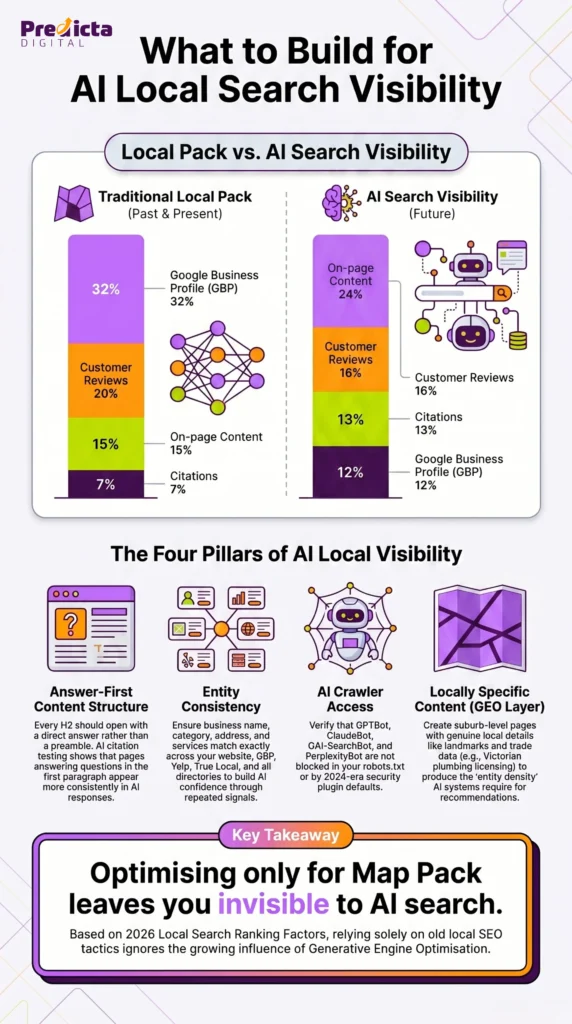
When ranking for AI recommendations, the weighting shifts significantly. On-page signals jump from 15% (local pack) to 24% (AI visibility) — the highest-weighted individual category. GBP signals drop from 32% to 12%. Reviews stay at 16%, but citation consistency and link signals both rise in importance. The practical implication: a business with a strong GBP but thin website content will rank well in the Map Pack but be largely invisible in AI-generated local recommendations.
This matters because 45% of consumers now use AI tools for local business recommendations, up from 6% a year ago (BrightLocal, 2026). Google’s AI Overviews now trigger on approximately 68% of local business queries, per Whitespark’s study of 540 manual queries across six local industries (Whitespark, 2026). A Melbourne business visible in the Map Pack but absent from AI recommendations is already missing a significant and growing portion of discovery traffic — without any ranking drop showing in Google Search Console.
What to build for AI local search visibility:
- Answer-first content structure: in our own AI citation testing, pages that answer the question in the first paragraph appear in AI responses more consistently than pages that build context first. Every H2 should open with a direct answer, not a preamble. The full picture is in our AI SEO statistics post.
- Entity consistency: your business name, category, address, and services should match exactly across your website, GBP, Yelp, True Local, and every other directory. AI systems build confidence in a business through repeated, consistent entity signals — inconsistency makes you ambiguous, and ambiguous businesses do not get recommended.
- AI crawler access: check that GPTBot, ClaudeBot, OAI-SearchBot and PerplexityBot are not blocked in your robots.txt. Security plugins and CDN configurations added “block AI bots” defaults in 2024 that are still silently blocking many Melbourne business websites. The full check process is in our guide to AI agent website visibility.
- Locally specific content: suburb-level pages with genuine local detail — nearby landmarks, state-specific regulations, local trade data — produce the entity density that AI systems use when recommending local businesses. A plumber’s page about Victorian plumbing licensing requirements is cited for Melbourne plumber queries at a rate that a generic “we cover all of Melbourne” page is not. This is the GEO (Generative Engine Optimisation) layer.
Citations and NAP: Still Necessary, No Longer Sufficient
Citation signals dropped from 13% of local pack ranking weight in 2020 to 7% in 2026 per Whitespark’s data. That is a significant decline, and it tracks with something most experienced local SEOs have observed: the days when building 50 directory listings produced meaningful ranking movement are gone. What citations still do is establish the data foundation that both Google and AI systems use to verify your business exists where you say it does.
For Melbourne businesses, the citations that carry the most weight:
- Google Business Profile: the primary source. Everything else feeds from it.
- Yellow Pages Australia (yellowpages.com.au): high-authority, Australian-specific
- True Local (truelocal.com.au): strong local signal for Australian SMBs
- Yelp Australia: high domain authority, AI systems cite it frequently for local recommendations
- Hotfrog Australia: established Australian directory
- Industry-specific directories: HiPages for trades, Healthengine for health, NDIS provider registries for disability services — vertical authority matters more than directory count
- Local council directories: Melbourne City Council and LGA business directories carry strong local entity signals
The non-negotiable is NAP consistency. Your business name, address, and phone number must match exactly across every listing — same abbreviations, same phone format, same trading name. A discrepancy between “Pty Ltd” and “Pty. Ltd.” or between “+61 3” and “03” is enough to create trust signal conflicts. Run a citation audit before building new listings. Cleaning up inconsistencies in existing listings produces more ranking improvement than adding new ones.
What to Actually Track
Measuring local SEO performance in 2026 requires tracking across both the traditional and AI visibility tracks. Your Google Search Console impressions and ranking positions tell you how the Map Pack is performing. They tell you nothing about whether your business is appearing in ChatGPT or Google AI Overview responses to local queries.
For traditional local search:
- Google Search Console: impressions, clicks, and average position for local keyword variants
- Google Business Profile Insights: calls, direction requests, website clicks, and photo views from your GBP listing
- Rank tracking: Map Pack position tracking across your target suburbs using a tool that captures local grid rankings, not just city-level averages — a business can rank #1 within 500 metres of its address and #8 at 2 kilometres
For AI search visibility:
- Manual prompt testing: monthly, ask ChatGPT, Perplexity and Google Gemini “best [service] in [suburb] Melbourne” — note whether your business appears and what sources are cited. This is the most direct measure available and is covered in depth in our AI SEO statistics post.
- SE Ranking AI Results Tracker (AIRT): tracks your brand mentions across six AI platforms and monitors citation frequency over time
- GA4 referral filtering: create a segment for traffic from known AI platform domains (perplexity.ai, chat.openai.com) to track whether AI-generated recommendations are driving actual visits
The metric that matters most is not rankings or citations — it is enquiry volume from organic and local channels. Rankings are the mechanism. Calls and contact form submissions are the outcome. Tracking both across both visibility tracks gives you a complete picture of whether your local SEO strategy is working.
Frequently Asked Questions
Your primary Google Business Profile category is the top individual ranking factor for local pack visibility, according to Whitespark’s 2026 Local Search Ranking Factors survey of 47 local SEO experts. At the category level, GBP signals overall (32%) carry the most weight, followed by reviews (20%) and on-page signals (15%). The single factor you have least control over — proximity to the searcher — accounts for roughly 55% of ranking decisions.
No — not directly. A Sterling Sky controlled study tracked 441 keywords across a 9-week posting period and found zero ranking movement from regular GBP posts. Posts have engagement value and are worth publishing for customer communication, but they are not a ranking signal. Focus your GBP effort on category selection, review velocity, profile completeness, and accurate business hours.
There is no fixed number, but Whitespark’s 2026 data shows businesses with 50 or more reviews are 266% more likely to appear in the Local Pack than businesses with fewer than ten. What matters more than volume is consistency: a steady flow of new reviews each week outperforms a large but stale review profile. Check the review count and recency of the top three businesses in your target suburb and use that as your benchmark.
The weighting shifts significantly. For AI search visibility, on-page content (24%) matters most — ahead of GBP signals (12%). For the Map Pack, GBP signals (32%) lead. A business with a strong GBP but thin website content will rank well in Maps but be largely invisible in ChatGPT or Perplexity recommendations. Whitespark added AI Search Visibility as a formal ranking category for the first time in 2026, reflecting how fast this layer has become a commercial priority.
The case for local SEO is stronger in 2026 than it was five years ago, not weaker — but it requires working both tracks. The Map Pack still captures 42% of clicks on local search queries (Backlinko, 2024), and 76% of consumers who conduct a local search on their smartphone visit a related business within a day (Think With Google, cited via Backlinko). At the same time, 45% of consumers now use AI tools for local business recommendations (BrightLocal, 2026). Businesses that work both tracks are capturing enquiries that single-track competitors are missing entirely.
Start with your robots.txt at yoursite.com/robots.txt. Check whether GPTBot, OAI-SearchBot, ClaudeBot and PerplexityBot are blocked — many Melbourne business websites are accidentally blocking these via security plugin defaults. Then do manual prompt testing: ask ChatGPT and Perplexity who the best [your service] in [your suburb] is, and check whether your business appears and what sources it cites. The full technical check is in our guide to AI agent website visibility.
Local search visibility in Melbourne in 2026 is built across two tracks — the Map Pack and AI recommendations — with overlapping but distinct ranking signals for each. The fundamentals (GBP, reviews, on-page content, NAP consistency) feed both. The difference in weighting means that optimising only one track leaves meaningful visibility on the table. An AI and local SEO visibility audit maps where your business currently stands across both and identifies the specific gaps worth closing first.