
Ecommerce SEO in the AI Era: Which Platform Is Actually Ready for AI Shopping?
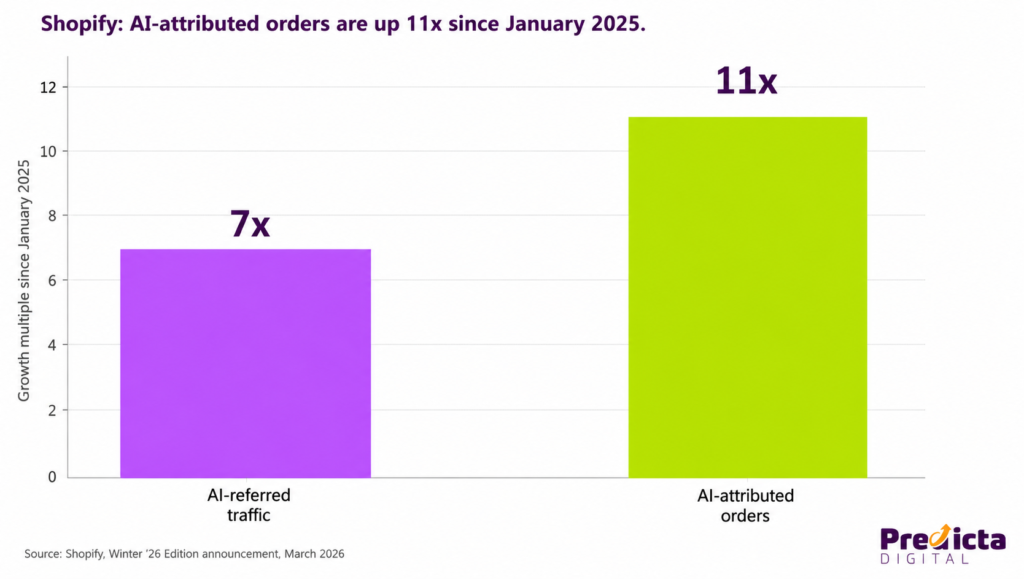
Ecommerce SEO used to mean three things: clean URLs, fast pages, and enough backlinks to outrank the next store selling the same product. Those fundamentals have not gone away. What has changed is who is reading your product pages. ChatGPT now has 880 million monthly active users, and Shopify’s own Winter ’26 announcement reports AI-referred traffic to merchants up 7x since January 2025, with AI-attributed orders up 11x. The question a platform answers is no longer just “can Google find this product,” it’s “can ChatGPT, Perplexity or Google’s AI Mode read this product well enough to recommend it.”
That second question has a different answer on every platform, and the gap between them is wider than most comparisons let on. This is a full rebuild of an older, thinner post on this blog. Pricing has moved, BigCommerce changed its entire fee structure in June 2026, and the AI shopping layer barely existed the last time this topic was covered here. What follows is what each of the five platforms Australian merchants actually choose between gives you, and does not give you, for SEO and AI visibility right now, with the source for every specific claim.
The AI Shopping Layer Is a Sales Channel Now, Not a Discovery Novelty
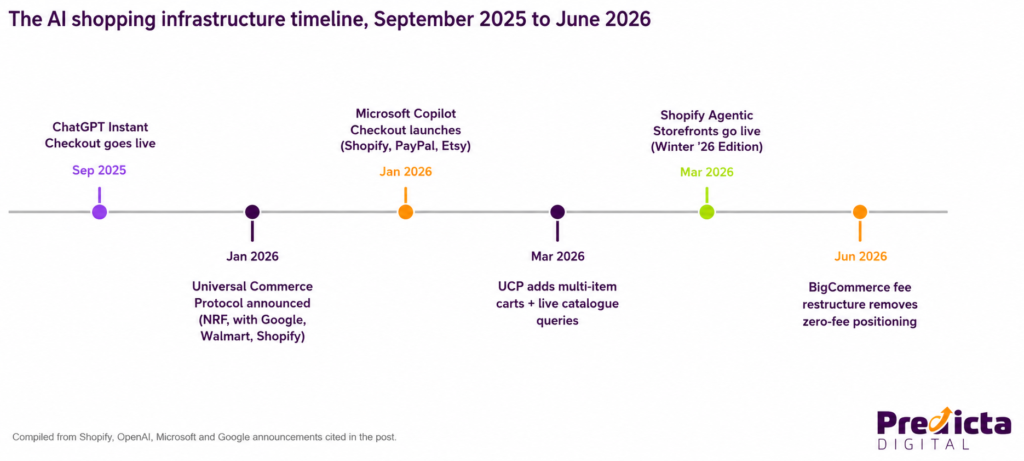
ChatGPT’s Instant Checkout has been live since September 2025. Google’s Universal Commerce Protocol, announced at NRF in January 2026 with Walmart, Target, Shopify and 20-plus partners, added multi-item carts and real-time catalogue queries by March. This is infrastructure, not a pilot, and the Ahrefs team’s own research on ChatGPT citations confirms the mechanism runs on retrieval and citation criteria distinct from Google ranking signals, which is exactly why platform choice matters here in a way it did not two years ago.
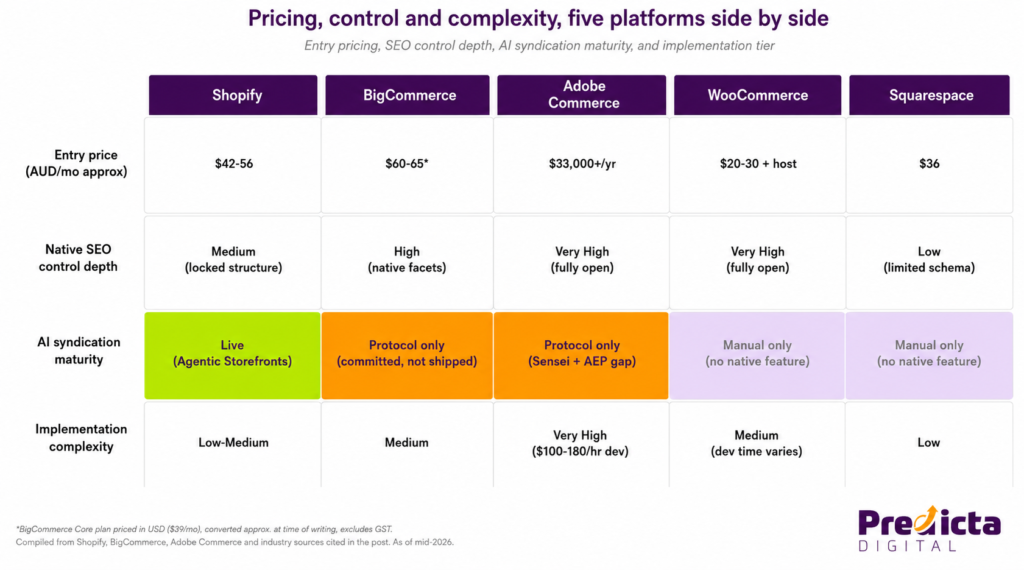
What differs sharply by platform is how much of the plumbing is built in versus how much a merchant or their agency has to build themselves. That gap is the actual subject of this post, more than price or theme count.
Shopify: The Only Platform With Native, One-Click AI Shopping Syndication
Shopify’s Basic plan in Australia runs AU$42/month on annual billing or AU$56/month monthly. Card fees via Shopify Payments range 1.4-1.75% plus 30 cents. Most established stores run 8-12 paid apps, adding AU$50-500 or more monthly, which means the real cost sits closer to AU$150-300/month once a theme, apps and processing are included, not the AU$42 headline.
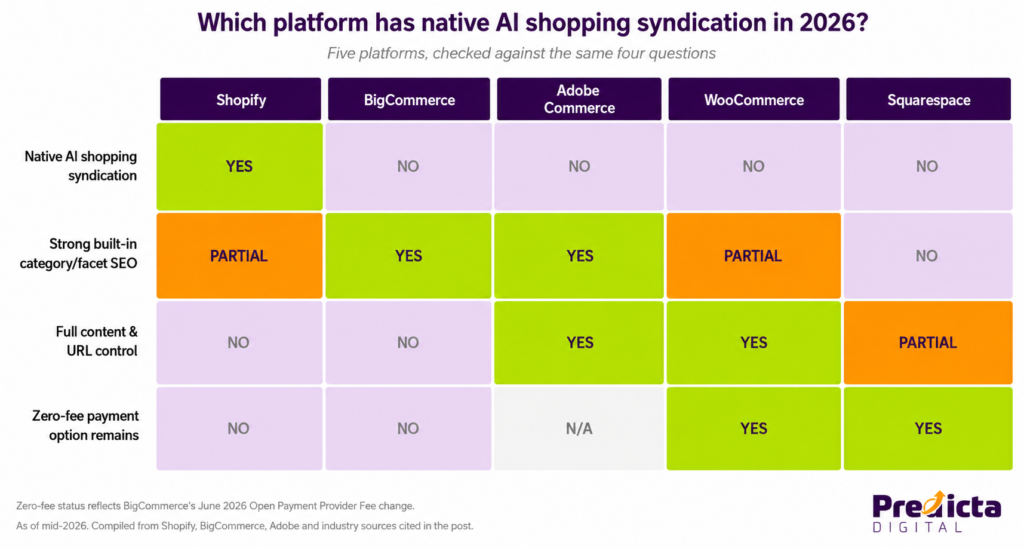
What Shopify has that nobody else on this list has yet is Agentic Storefronts. Shopify’s own Winter ’26 Edition announcement states that a merchant enables Shopify Catalog in admin settings, and eligible products become discoverable through channels including ChatGPT, Google AI Mode, Gemini and Microsoft Copilot. Shopify co-developed the Universal Commerce Protocol directly with Google, and the same announcement reports AI-referred traffic to merchants up 7x since January 2025, with AI-attributed orders up 11x. For eligible stores and supported channels, this removes much of the custom integration work that other platforms still require. It is not universal: Shopify’s own documentation notes that Google AI Mode and Gemini agentic checkout are in early access and, per its direct-checkout guidance, currently limited to stores based in the United States selling to US customers. We covered the specific eligibility rules for Australian stores here, because access is not uniform across every channel yet.
On the plain SEO side, Shopify’s technical foundation is solid but deliberately locked down: URL structure follows a fixed /products/ and /collections/ pattern that cannot be fully restructured, and canonical handling is automatic rather than configurable. That is a tradeoff, not a flaw. It removes most of the classic ecommerce SEO failure modes, duplicate faceted URLs, broken canonicals, at the cost of the deep structural control a platform like Magento or WooCommerce allows. A Shopify SEO audit is the fastest way to find out which side of that tradeoff is actually costing a specific store traffic.
BigCommerce: Strong Built-In SEO Architecture, a Weakened Fee Advantage
BigCommerce restructured its entire plan naming and fee model on June 1, 2026: Standard became Core (US$39/month), Plus became Growth (US$105/month), Pro became Scale (US$399/month), and Enterprise became Performance. All prices are USD, excluding GST, which Australian merchants need to add on top. Plans are also tied to trailing 12-month GMV thresholds, Core caps out around US$30,000 in annual sales before a forced upgrade.
The single biggest change, confirmed directly on BigCommerce’s own 2026 pricing update page: BigCommerce weakened one of its clearest historical cost advantages, zero transaction fees on any payment gateway. From June 2026, an Open Payment Provider Fee applies to any gateway outside BigCommerce’s preferred list (Stripe, PayPal/Braintree, Adyen, Checkout.com, Klarna, Afterpay), at rates that mirror Shopify’s structure: 2% on Core, 1% on Growth, 0.6% on Scale. Merchants who stay on an embedded, preferred provider are not affected in the same way, but the fee-free positioning that used to be BigCommerce’s entire pitch against Shopify no longer holds universally.
What remains genuinely strong is the built-in feature depth. BigCommerce ships with true hierarchical category structures, faceted search, multi-currency and multi-storefront support natively, capabilities that require paid apps on Shopify. One enterprise merchant review on Capterra specifically noted that when migrating from WooCommerce and evaluating Shopify Plus against BigCommerce Enterprise, Shopify’s Collections could not replicate BigCommerce’s native category and subcategory depth without relying on apps. For SEO specifically, that structural depth translates into cleaner category architecture without the URL parameter sprawl that plagues platforms with weaker native faceting.
On AI shopping, BigCommerce has committed to supporting the Universal Commerce Protocol as a partner alongside Shopify, Google and Walmart, but as of mid-2026 it does not have an equivalent one-click syndication feature live for merchants the way Shopify’s Agentic Storefronts is. The native ecommerce architecture is arguably the strongest on this list technically; the AI shopping layer is still catching up to Shopify’s head start.
Adobe Commerce (Magento): The Most Powerful Platform, and the Easiest to Break
Adobe Commerce, still commonly called Magento, is built for businesses at $5M-plus annual revenue with complex B2B requirements. Licensing runs from roughly US$22,000 to US$125,000-plus per year depending on GMV, according to mgt-commerce’s 2026 Adobe Commerce guide, on top of development costs typically US$100-180 an hour and hosting. The free, open-source version, Magento Open Source, removes the licence fee but keeps the same technical demands.
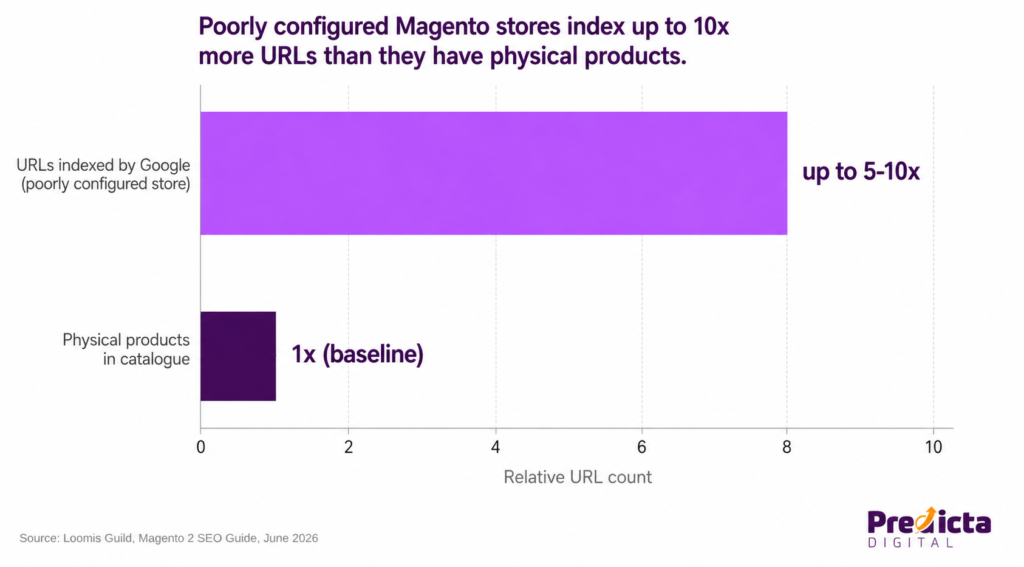
Magento’s SEO paradox is that it is one of the most SEO-capable platforms available in terms of raw architecture, and one of the easiest to break. Loomis Guild’s Magento 2 SEO Guide documents that the default faceted navigation, filtering by size, colour, price, generates thousands of near-duplicate URL parameter combinations, and that enterprise audits reveal poorly configured Magento sites carrying 5 to 10 times more indexed URLs than physical products in the catalogue. That burns crawl budget that should be going to actual category and product pages. The fix, per the same guide, means strict canonical configuration under Stores > Configuration > Catalog > Search Engine Optimization, blocking filter URLs from XML sitemaps, and applying noindex-follow tags to non-essential filtered views, none of which happens by default.
Site speed compounds the problem. Magento’s core is a heavy JavaScript stack, and Search Engine Journal’s technical guide to Magento SEO issues, written by Dan Taylor, sets Google’s 2026 benchmark for Interaction to Next Paint at under 200 milliseconds for “good,” with anything over 500ms rated poor. Default Magento themes routinely miss this without intervention, typically a shift to the Hyvä theme framework, which strips out the legacy RequireJS and Knockout.js overhead, or a full headless rebuild.
On AI, Adobe’s native tool is Sensei, handling AI-powered semantic search, product recommendations, and intelligent category merchandising, genuinely useful and included in the platform. More advanced agentic or personalisation workflows, per the mgt-commerce guide cited above, often move the project beyond Adobe Commerce alone and into Adobe Experience Platform or adjacent Adobe products. That can materially increase total software and implementation cost. A third-party 2026 analysis cites Adobe Commerce licence tiers from roughly US$22,000/year to US$125,000-plus/year depending on GMV, with broader total cost of ownership often substantially higher once hosting, development and maintenance are included. Webscale’s analysis of agentic commerce across Adobe Commerce, Magento and Shopware goes further: it argues none of the major enterprise platforms, Adobe included, have yet solved the first-party data problem that makes agentic commerce actually reliable, regardless of which protocols they support on paper.
WooCommerce: The Only Platform Where You Own the SEO Outcome Directly
WooCommerce is a free WordPress plugin, not a hosted platform. There is no subscription fee for the plugin itself, but a merchant needs separate hosting, typically from around AU$20-30/month for a small store, plus domain and SSL. WooCommerce powers roughly 20%-plus of global ecommerce sites by some measures, largely riding WordPress’s dominant CMS market share.
For SEO specifically, WooCommerce is consistently rated the strongest platform for organic control, because it inherits WordPress’s content management depth. URL structure, permalink rules, canonical tags, and content architecture are all directly editable, paired with Yoast or RankMath for on-page optimisation at a level no hosted platform matches without developer intervention. If a merchant’s growth strategy leans heavily on content and organic search, and most Australian SME ecommerce should, WooCommerce hands over more direct control of that outcome than Shopify, BigCommerce or Squarespace.
The tradeoff is that nothing happens automatically. WooCommerce has no equivalent to Shopify’s Agentic Storefronts. AI shopping visibility depends entirely on the same fundamentals covered in our piece on AI agent visibility: plain crawlable HTML rather than JavaScript-rendered pricing, structured product schema, descriptive URLs. A WooCommerce store can absolutely be cited and recommended by AI shopping assistants, and its open architecture means a well-configured store can expose product feeds and structured data more precisely than a locked-down hosted platform allows. It requires deliberate technical setup rather than a toggle in an admin panel, the same way the platform’s SEO strength requires deliberate configuration rather than arriving out of the box, which is exactly what a WooCommerce SEO review is built to catch before it costs traffic.
Squarespace: Strongest Design, Weakest Ecommerce and AI Shopping Depth
Squarespace’s Core commerce plan runs around AU$36/month, with unlimited storage and no transaction fees on Commerce plans, a genuine cost advantage over both Shopify and the new BigCommerce fee structure. Squarespace began as a website builder and added ecommerce later, and that heritage still shows in what it does well: templates are more polished out of the box, and the editor requires the least technical comfort of any platform on this list.
The ecommerce and SEO ceiling is correspondingly lower. Squarespace’s extension marketplace runs to roughly 50-100 integrations against Shopify’s several thousand or BigCommerce’s native depth. Structured data and schema options are more limited, and there is no equivalent to WooCommerce’s granular content control or BigCommerce’s native faceted search. Squarespace’s own AI tools, Blueprint AI for site generation and an AIO Scanner for AI search visibility, are aimed at content and design, not commerce-specific tasks like inventory or AI shopping syndication.
Squarespace has no native AI shopping syndication feature. Visibility in ChatGPT or Google AI Mode depends on the same basic technical SEO fundamentals as WooCommerce, without either Shopify’s automated syndication or WooCommerce’s underlying flexibility to build a custom solution. The right fit is specific: a business selling a small, low-SKU catalogue (roughly under 50 products) alongside a content-led site, such as a studio, consultancy, or creator brand, where the website’s primary job is presentation and booking rather than catalogue-scale ecommerce. It is not the platform to build on if AI shopping visibility or a growing product range is a near-term priority.
The Technical Baseline Every Platform Still Needs, Regardless of Which One You Choose
Every platform on this list, including Shopify with its automated syndication, still needs the same underlying technical fundamentals to actually get cited and recommended by AI shopping assistants.
Product data has to be in plain, crawlable HTML rather than rendered client-side through JavaScript. Pricing, stock status, variants and specifications that only appear after client-side scripts execute can be harder for crawlers and AI retrieval systems to parse reliably, a problem that affects Magento and custom WooCommerce builds more often than hosted platforms, but is not unique to either.
Structured product schema now matters more directly. Ahrefs’ own research into how ChatGPT selects and cites sources found retrieval and citation depend heavily on clean, well-structured page data rather than backlink authority alone, which lines up with NRF’s 2026 guidance recommending product titles of 30-plus characters, descriptions of 500-plus characters, and GTINs populated on every listing. None of the five platforms covered here does this automatically without deliberate setup, Shopify’s syndication only works well once the underlying product data meets this bar, which is the specific thing an AI search visibility check tests for rather than assumes.
Site speed against 2026’s Core Web Vitals thresholds, particularly the new INP standard documented in the Search Engine Journal guide cited above, is the technical requirement most likely to be silently failing on an older or heavily customised store, on any platform, not just Magento’s well-documented version of the problem.
The Ecommerce AI Visibility Readiness Check
Before choosing or migrating platforms, it’s worth checking five things directly, rather than assuming a platform’s marketing page has already covered them.
Product data access. Are product titles, prices, stock status, variants and specifications visible in crawlable HTML, not locked behind a script that has to run first?
Structured data quality. Are Product, Offer, Review, Breadcrumb and Organisation schema clean, complete and consistent across the catalogue, not just present on a handful of flagship pages?
Catalogue architecture. Can categories, filters and product variants be crawled without generating duplicate or low-value URL bloat, the exact failure mode covered in the Magento section above?
AI channel eligibility. Does the platform support native or feed-based AI shopping discovery for the specific markets the business actually sells into, rather than the markets a feature announcement was written for?
Commercial pathway. If an AI assistant recommends a product, does the landing page it links to support the same promise, price, trust signals, shipping, returns and conversion clarity, or does the recommendation land on a page that undoes the work?
This is the framework we use in ecommerce SEO and AI visibility audits. The platform matters, but the audit is what actually shows whether the product data, schema, crawlability and commercial page experience are ready to be recommended, rather than assumed to be.
Which Platform Actually Fits, Once the AI Layer Is Part of the Decision
For a dedicated store planning to scale past a few dozen products or move quickly into AI shopping channels, Shopify’s automated syndication is a genuine, currently unmatched advantage, at a real ongoing cost in fees and app dependency.
For a business with complex catalogue structure, multi-storefront needs, or B2B requirements that does not want to pay Magento-level implementation costs, BigCommerce’s native feature depth is still strong, but the June 2026 fee change means the classic “BigCommerce is cheaper because no transaction fees” pitch needs to be re-modelled with real numbers before it’s assumed to hold.
For enterprise-scale, highly complex B2B catalogues where the business has budget for proper implementation and ongoing technical management, Adobe Commerce remains the most capable platform on this list, provided the crawl-budget and Core Web Vitals traps are actively managed rather than left on default settings.
For a business with existing WordPress infrastructure and a genuine SEO and content strategy, WooCommerce still hands over the most direct control of organic outcomes of any platform here, at the cost of nothing happening automatically.
For a content-first business with a smaller catalogue, Squarespace remains the easiest platform to run, with the clear understanding that both SEO depth and AI shopping visibility will need to be built the hard way.
None of these five platforms hands a merchant AI shopping visibility for free. Shopify has automated the syndication step for merchants who meet its technical bar. BigCommerce and Adobe Commerce have committed to the same protocols but have not shipped an equivalent one-click feature yet, and Webscale’s own analysis argues none of the enterprise platforms have solved the underlying first-party data problem regardless. WooCommerce and Squarespace never will by default, because neither platform is built around that kind of native automation. What changes the outcome, on every single one of these platforms, is whether the underlying product data, page speed, and schema are actually right. An ecommerce SEO assessment is how that gets checked properly, platform by platform, rather than assumed from a features page. Platform choice decides how much of that work is done for you. It does not decide whether the work gets done.
Want to know where your current platform actually stands, not where the marketing page says it stands?
Get in touchFrequently Asked Questions
Which ecommerce platform is best for AI shopping visibility in 2026?
Shopify currently has the strongest native AI shopping infrastructure through Agentic Storefronts, which automatically syndicates eligible product catalogues into ChatGPT, Google AI Mode, Gemini and Microsoft Copilot without a separate integration. BigCommerce and Adobe Commerce have committed to the same underlying protocols but have not shipped an equivalent one-click feature. WooCommerce and Squarespace merchants can still achieve AI shopping visibility through strong technical SEO, but it requires deliberate manual setup rather than a built-in toggle.
Did BigCommerce really remove its no-transaction-fee advantage?
Yes, from June 1, 2026, confirmed on BigCommerce’s own pricing update page. BigCommerce introduced an Open Payment Provider Fee on its self-service plans (Core, Growth, Scale) for any payment gateway outside its preferred list, at rates that mirror Shopify’s own transaction fee structure. Merchants using an Embedded Payment Provider such as Stripe or PayPal/Braintree are not subject to the fee, but the platform’s long-standing zero-fee pitch no longer applies universally.
Is Magento or Adobe Commerce still worth using for SEO in 2026?
Yes, but only with active technical management. Magento’s architecture is genuinely SEO-capable, but the default faceted navigation configuration commonly generates 5 to 10 times more indexed URLs than physical products, wasting crawl budget, according to Loomis Guild’s 2026 Magento SEO guide. Combined with Core Web Vitals thresholds that stock Magento themes often miss, the platform requires ongoing technical attention, typically canonical configuration, sitemap management, and a performance-focused theme like Hyvä, to perform well rather than working out of the box.
Does WooCommerce need special work to show up in AI search results?
Yes. WooCommerce has no built-in AI shopping syndication feature. Visibility in ChatGPT, Perplexity or Google AI Mode depends on the same technical fundamentals as any platform: plain crawlable HTML instead of JavaScript-rendered product data, structured schema, and descriptive URLs. WooCommerce gives a merchant or agency more direct control to build this than a hosted platform, but none of it happens automatically.
Is switching platforms worth it just to get better AI shopping visibility?
Not on that basis alone. AI shopping visibility depends heavily on product data quality, page speed and schema, fundamentals that apply on every platform. A migration is worth considering if a business is also outgrowing its current platform’s broader ecommerce or SEO capability, not for AI visibility in isolation. Fixing the technical fundamentals on an existing platform is usually the faster, cheaper first step.