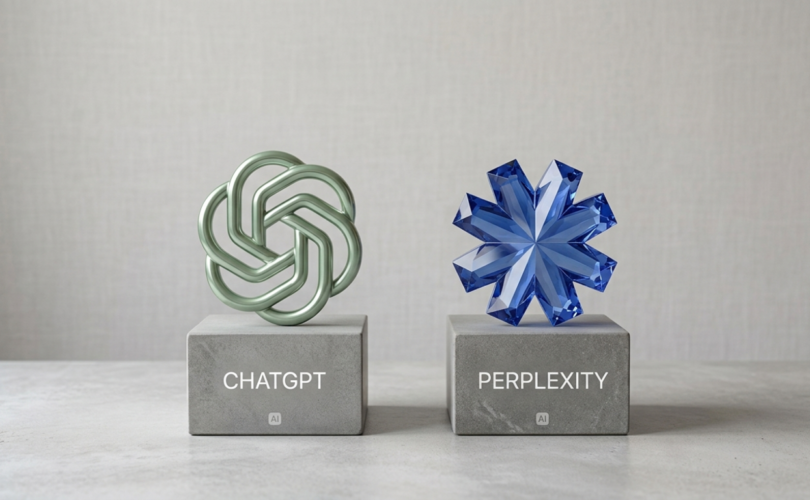

ChatGPT vs Perplexity: Same Brand, Two Completely Different Verdicts
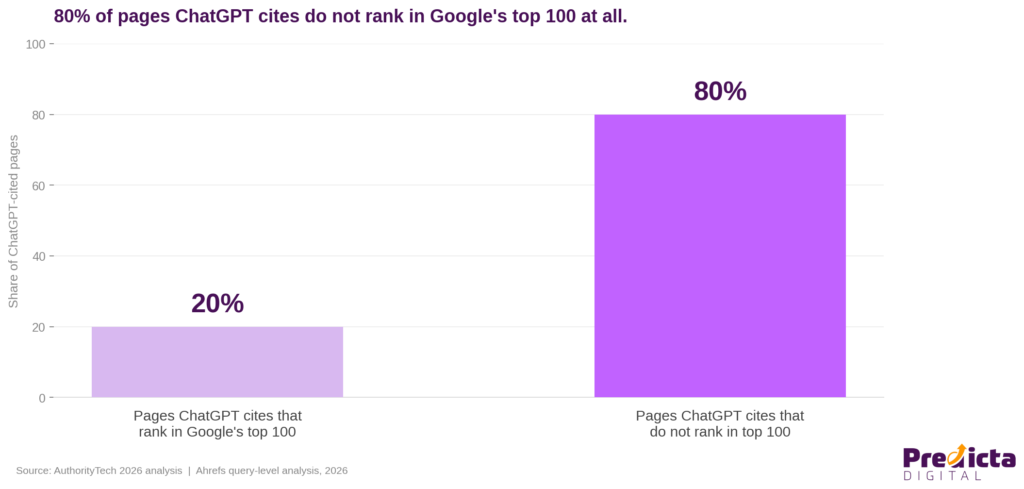
I ran the same query on ChatGPT and Perplexity: “good ai seo agencies in melbourne.” Same words. Same day. The two platforms returned almost entirely different agency lists.
ChatGPT returned three agencies under a specific category it created: “Agencies specifically pushing AI SEO / GEO / AEO.” Digital Autopilot. SkyScale. Predicta Digital. It grouped them by positioning type, with descriptions drawn from each agency’s content and training signals.
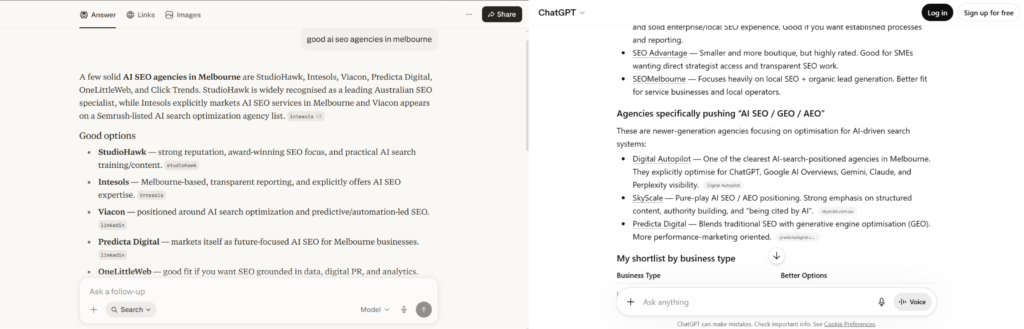
Perplexity returned six agencies under a single “Good options” heading: StudioHawk, Intesols, Viacon, Predicta Digital, OneLittleWeb, Click Trends. No categories. No positioning analysis. Just a flat list of what it retrieved from a real-time web search. Of those six, five do not appear on ChatGPT’s list at all.
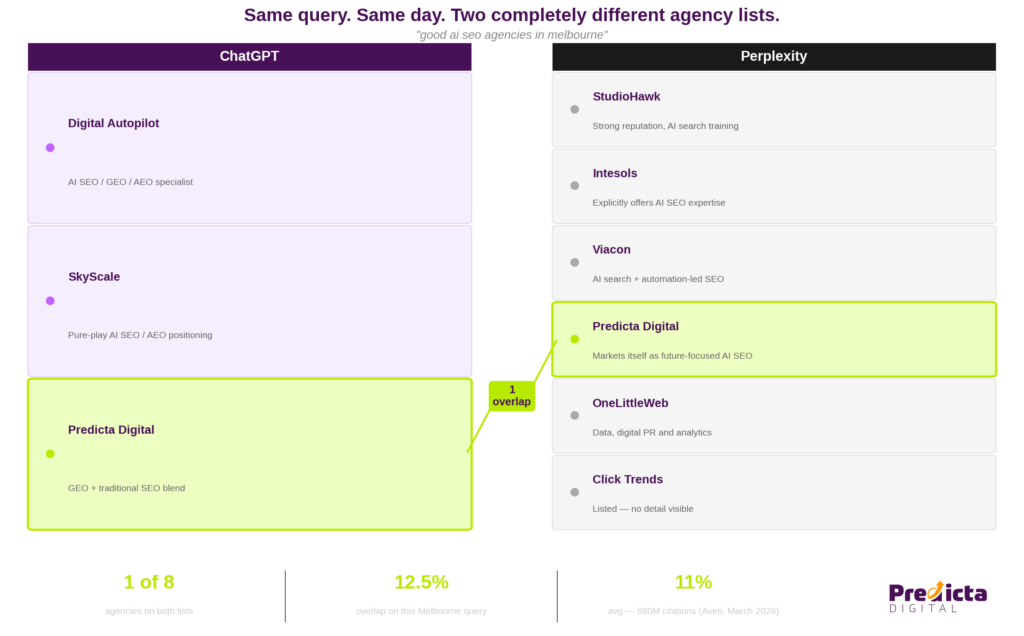
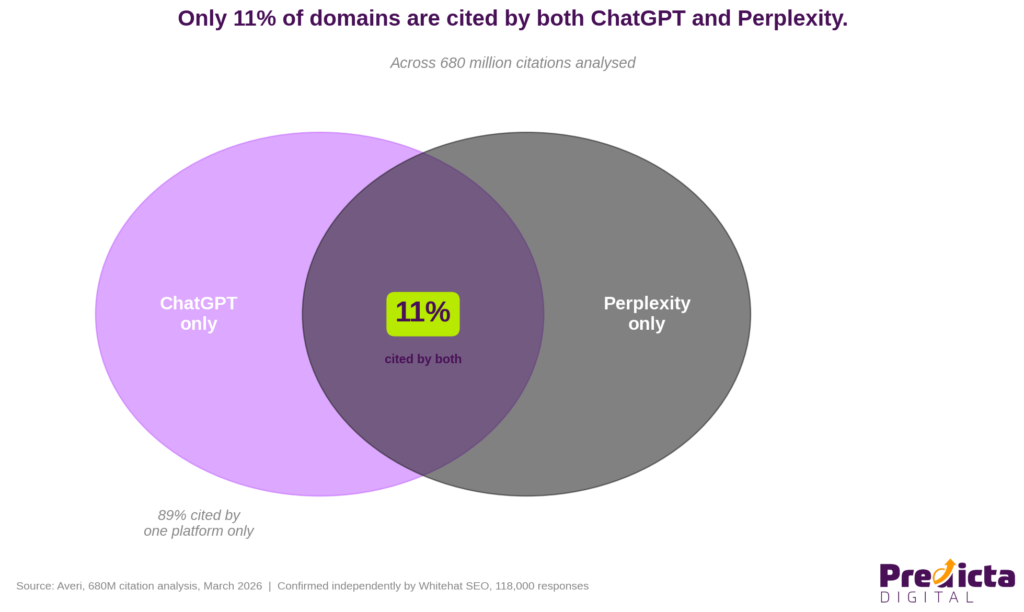
One agency appeared on both lists. Predicta Digital. On ChatGPT via its website. On Perplexity via LinkedIn. That’s 12.5% overlap on a real Melbourne query. Averi’s analysis of 680 million AI citations found 11% average domain overlap between the two platforms. These screenshots independently replicate that finding.
What I want to walk through is why this happens, the mechanism behind the divergence, and what it means for any Melbourne service business trying to get found in AI search. The Predicta situation is one data point. The platform difference is the real story.
There is one more thing worth noting. Predicta’s Google rankings dropped after a platform migration. ChatGPT has still cited it consistently across months of testing. Rankings and AI visibility are running on different tracks entirely. That disconnect matters, and I will come back to it.
KEY FINDINGS
- 1 agency appeared on both lists from the same Melbourne query — 12.5% overlap on a real search. Averi’s 680 million citation analysis found 11% average overlap across platforms, March 2026.
- Superlines documented citation volume variance of up to 615x for the same brand between platforms, March 2026.
- ChatGPT answers roughly 60% of queries from training data and 40% from real-time Bing retrieval. Contently meta-analysis, 2026.
- Perplexity performs a real-time web search for every single query. It cited content published in the last 30 days at an 82% rate. Leapd, 2026.
- 80% of pages ChatGPT cites do not rank on page one of Google. AuthorityTech, 2026.
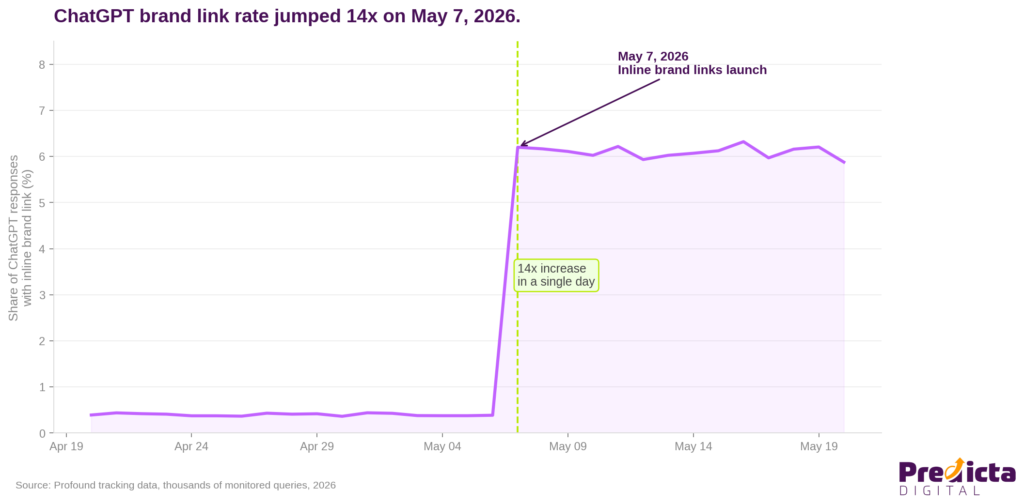
- On May 7, 2026, the share of ChatGPT responses containing an inline brand link jumped from 0.4% to 6.2% — a 14x increase in a single day. Homepage referral rate lifted from 26-32% to around 60%. Profound tracking data.
- Predicta Digital’s Google rankings dropped after a platform migration. ChatGPT cited the homepage 100% of the time across searches in the past month. The two systems are running independently.
ChatGPT and Perplexity Are Not Running the Same Algorithm
Most businesses treating AI search as a single channel are making a fundamental error. ChatGPT and Perplexity are architecturally different. They read different pages, weight different signals, and reach different conclusions about the same brand.
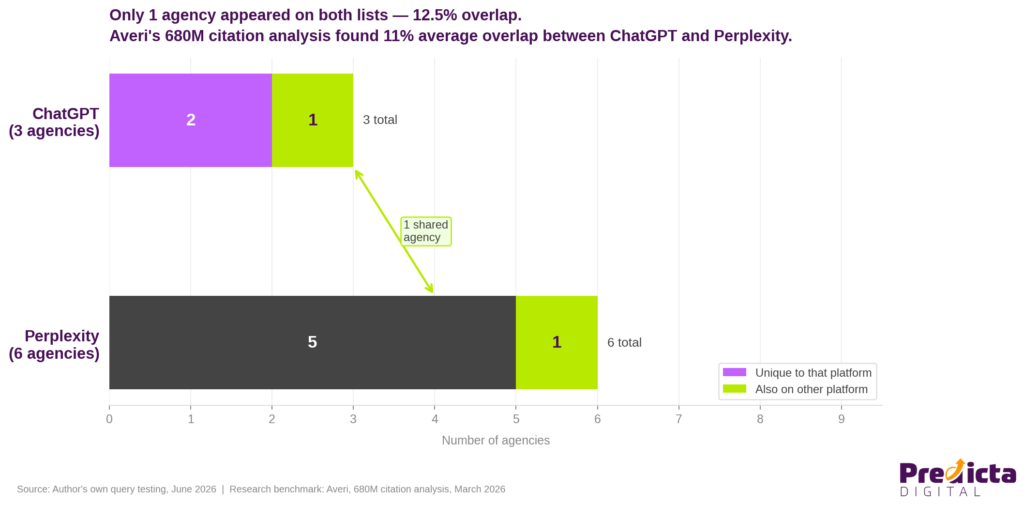
ChatGPT has two modes. Roughly 60% of queries are answered from parametric knowledge: patterns encoded during model training, with a knowledge cutoff of August 2025 for GPT-5 series models. The remaining 40% uses real-time web retrieval via Bing’s index. These modes behave differently.
Training-mode answers pull from what the model learned across millions of documents before the cutoff. Retrieval-mode answers query Bing, extract the most relevant sections of live pages, and synthesise a response. A brand densely co-mentioned with a topic in training data has a structural advantage in training mode. A brand with fresh, well-indexed Bing content has the advantage in retrieval mode. Most brands optimise for neither, because they do not know the split exists.
Perplexity works completely differently. It performs a real-time web search for every single query. No knowledge cutoff. No training data reservoir. It draws from multiple search APIs including Google and Bing, retrieves live candidate pages, and synthesises an answer with inline citations. A blog post published this morning can be cited by Perplexity this afternoon. Leapd’s 2026 analysis found Perplexity cited content published in the last 30 days at an 82% rate. Fresh beats established, every time.
This is why the same brand can get two different verdicts. ChatGPT found Predicta’s recent AI SEO blog content in its training data and retrieval index and described it accordingly. Perplexity hit the live site, read different pages, and reached a different conclusion. Same domain. Two different page sets. Two different brand identities.
80% of What ChatGPT Cites Does Not Rank on Page One of Google
This is the number that changes how you think about AI visibility.
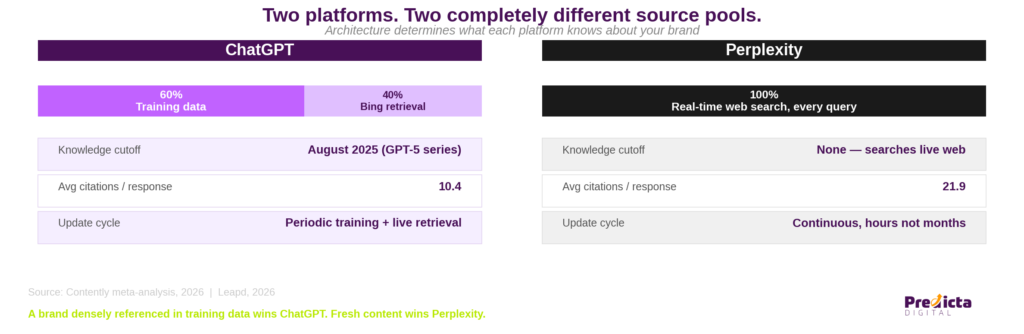
AuthorityTech’s 2026 analysis found that 80% of the pages ChatGPT cites do not rank on the first page of Google. A separate Ahrefs query-level analysis found 80% of ChatGPT-cited URLs do not rank in Google’s top 100 at all. Not second page. Not top 20. Outside the top 100.
I saw this with Predicta. The platform migration knocked the Google rankings. The ChatGPT citations did not move. Not a little. Not at all. The site kept showing up in AI recommendations while the organic positions were gone. That tells you something: these are not two dials on the same board. They run on different inputs entirely.
Most businesses assume the two move together. Rank well on Google, show up in AI search. The data does not support that.
Ranking still matters. A strong Google position gets you into Bing’s retrieval index, which feeds around 40% of ChatGPT answers. So it helps. But it is not what determines whether ChatGPT names you. That is a different question with a different answer.
The Content That Gets Crawled Determines the Brand Identity You Get
Here is the mechanism behind the divergence, stated plainly.
ChatGPT encountered Predicta’s AI SEO blog content in its training data and in Bing retrieval. The GEO technical foundations post, the AI SEO statistics post, the Shopify agentic storefront piece. That content is specific. It positions Predicta as a practitioner working in AI search optimisation. The model built its description from that content.
Perplexity ran a real-time search and read different signals — pulling from LinkedIn rather than the website itself when it surfaced Predicta at all. It is not wrong. It is reading whatever it retrieves, and what it retrieves is not always the page that best represents the business.
This is a content architecture problem, not a ranking problem. Different pages send different signals about what a business does. The AI platforms resolve that inconsistency differently based on which pages they happen to read.
Superlines’ March 2026 cross-platform analysis documented variance of up to 615x in citation volume for the same brand between platforms. That is not noise. That is the result of two systems drawing from two different page sets and arriving at different conclusions.
The brand you project on AI search is a function of which specific pages each platform reads. Not your homepage alone. Not your rankings. The pages.
The May 7 Update Explains Where the Leads Are Coming From
On May 7, 2026, OpenAI changed how ChatGPT surfaces brand citations. Before that date, brands appeared as bold names with citation chips at the bottom of a response. After May 7, those names became inline clickable links pointing directly to the brand homepage.
Profound’s tracking across thousands of monitored queries found the share of ChatGPT responses containing an inline brand link jumped from 0.4% to 6.2% on that single day. A 14x increase. The homepage referral rate lifted from 26-32% to around 60% and has stayed there.
This is why Predicta is getting leads from ChatGPT despite the Google rankings drop.
ChatGPT is not sending people to the blog posts it read and learned from. It is surfacing the brand by name in response to queries like “recommend AI SEO agencies in Melbourne” and linking directly to predictadigital.com.au. The content built the citation eligibility. The May 7 update built the traffic mechanism.
The content that earns the citation and the page that receives the traffic are often different. The blogs did the positioning work. The homepage receives the click. Both need to be right.
The 11% Overlap Means Your Measurement Is Almost Certainly Wrong
If you are tracking your AI visibility on one platform, you are missing 89% of the citation landscape.
Averi’s analysis of 680 million AI citations found only 11% of domains are cited by both ChatGPT and Perplexity. Whitehat SEO’s independent study of 118,000 responses confirmed the same figure. Slate HQ’s 90-day study tracking 300,000+ citations for six B2B brands found the per-platform citation profiles were so different they looked like different brands.
The gap is not narrowing. Each platform is building its own citation graph based on its own architecture, and those graphs are becoming more distinct over time, not less.
What this means practically: a business can dominate ChatGPT recommendations for its category and be almost invisible on Perplexity. It can have strong Perplexity citations and generate very little ChatGPT traffic, because the May 7 inline link update has concentrated ChatGPT’s referral volume into brands it already cites. It can have Google AI Overview visibility that correlates with traditional rankings but has essentially no overlap with ChatGPT’s citation pool.
These are three separate visibility problems. They share some inputs: strong content, entity consistency across the web, credible third-party mentions. But they require platform-specific attention.
How to Find Out Where You Actually Stand
The temptation after reading this is to check your AI visibility on one platform and call it done. That misses the point.
Start with the two-platform test. Run the same query on ChatGPT and Perplexity: “recommend [your service] in [your city].” Then, in the same session, ask: “what about [your business name]?” Read the description each platform gives you. Compare it to what you actually do and how your site describes what you do.
If the descriptions diverge, you have a content architecture problem. The platforms are reading different pages and reaching different conclusions. That is the diagnosis.
The second step is to identify which pages are being cited. ChatGPT will show inline links or citation chips. Perplexity shows numbered citations with sources. Note the specific URLs. If the platforms are reading your homepage but not your service-specific content, or reading content that predates a positioning shift, that is the gap.
The third step is platform-specific.
For ChatGPT: content needs to be indexed by Bing, crawled by GPTBot, and make its way into retrieval and future training updates. Make sure GPTBot is allowed in your robots.txt. Submit your sitemap to Bing Webmaster Tools. Structure content so the answer leads, not preamble. ChatGPT extracts the most relevant section of a page, not the whole thing. If your positioning is buried in paragraph four, it is likely being missed.
For Perplexity: freshness is the single most direct lever. The 82% citation rate for content published in the last 30 days is not a marginal effect. It is the architecture. Update key service pages. Publish with year signals in headings. Keep your specialist positioning current and on the homepage, not only in blog posts.
For both platforms: third-party mentions compound the primary content. Predicta’s consistent ChatGPT citations come partly from the blog content and partly from being mentioned in external contexts: directories, industry discussions, comparison sources. An AI platform that sees your brand consistently associated with a topic across multiple independent sources has higher confidence in recommending you than one drawing from your domain alone.
The two agency lists tell you more about how AI search actually works than most guides on the topic.
Same query. Same day. Two platforms returning almost entirely different answers. That is not a glitch. It is the system working exactly as designed, reading different pages and reaching different conclusions.
Predicta’s AI citations survived a Google rankings drop because the blog content had already done the positioning work. The homepage benefited from the May 7 update without being the source of the citation. The Perplexity read was weaker because the homepage copy had not caught up with what the blog content was signalling.
That is the pattern I keep seeing across service business accounts. Two systems running independently, rewarding different things, and neither one giving you the full picture on its own.
If you want to understand where your business stands across both platforms and what the specific content gaps are, a GEO and AI visibility audit is the most direct way to find out.
Frequently Asked Questions
Because they read different pages. ChatGPT answers around 60% of queries from training data and 40% from real-time Bing retrieval. Perplexity searches the live web for every query with no knowledge cutoff. If your recent content signals something different to your homepage or older directory listings, each platform reaches a different conclusion. They are not wrong. They are reading different evidence.
It helps, but it is not the primary driver. 80% of pages ChatGPT cites do not rank in Google’s top 100. Strong rankings increase your probability of appearing in Bing’s retrieval index, which feeds ChatGPT’s retrieval mode. But citation eligibility is determined more by how consistently your brand is associated with a topic across authoritative sources than by ranking position alone.
Only 11% of domains are cited by both platforms, across 680 million citations analysed by Averi in March 2026. The two platforms have almost completely separate citation graphs. A brand that dominates one can be nearly absent from the other. Audit both separately and identify which page sets each is reading about your business.
It depends on the platform. Perplexity can cite content within hours of indexation. It searches the live web in real time. ChatGPT’s retrieval mode via Bing picks up fresh content faster than its training data cycle, but training updates run on a longer timeline. For Perplexity, recency is a direct lever. For ChatGPT, the combination of Bing indexation and consistent third-party brand mentions matters more.
ChatGPT encountered Predicta’s AI SEO blog content in its training data and Bing retrieval and built its description from that. Perplexity searched the live site and surfaced different signals, citing LinkedIn rather than the website itself. The blog content and the other indexed pages were sending different signals about what the business does. Each platform read whichever signals it found and drew its own conclusion.