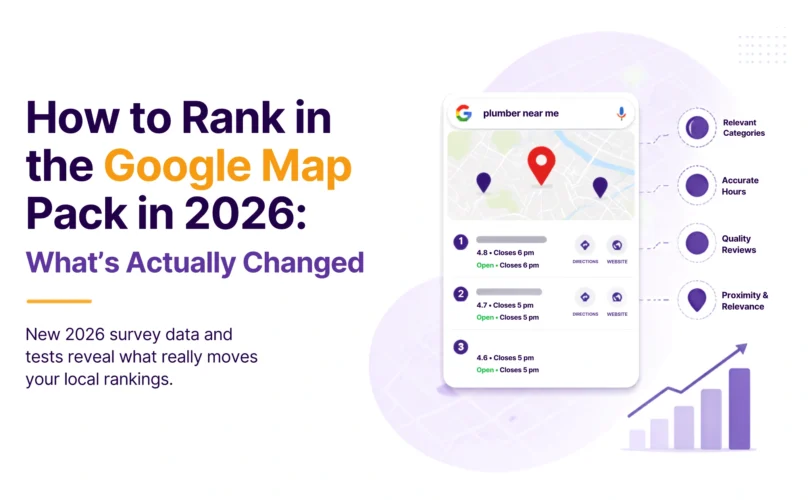

How to Rank in the Google Map Pack in 2026: What’s Actually Changed
A plumber in Melbourne’s west asked me a fair question recently: he posts to his Google Business Profile every week like every guide tells him to, so why hasn’t he moved past position four in the Map Pack for two years? Part of the answer is that the posting habit was probably never the lever he thought it was.

KEY FINDINGS
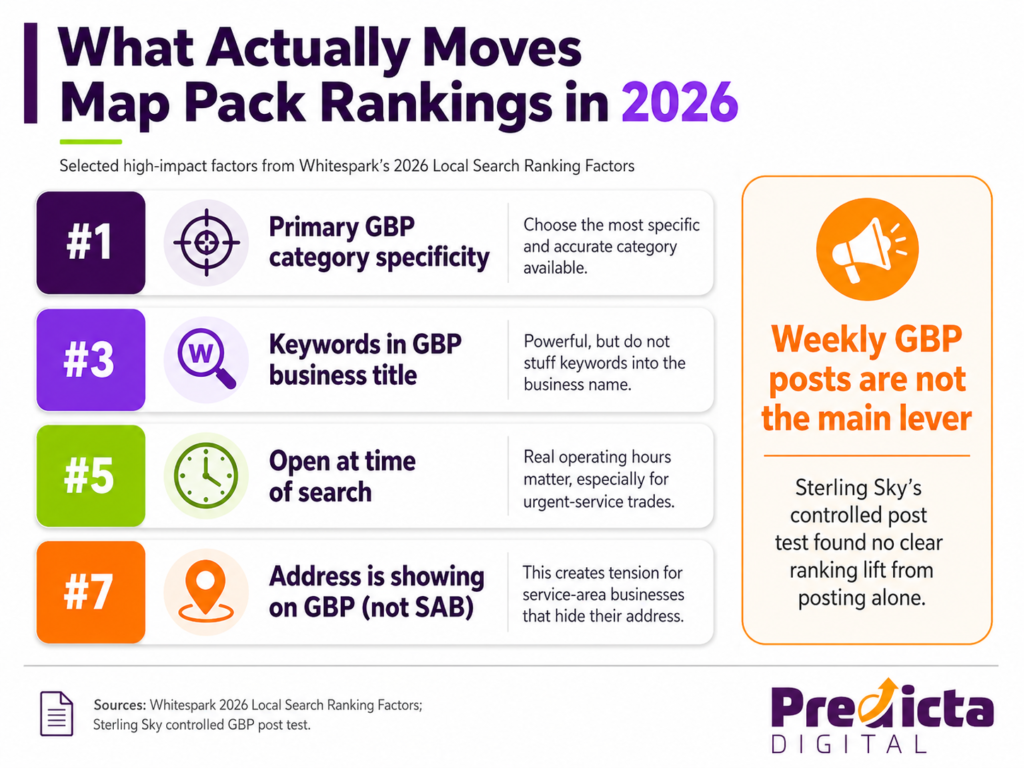
- Whitespark’s 2026 Local Search Ranking Factors survey, 47 local SEO practitioners scoring 187 factors, found GBP primary category specificity is the single highest-weighted individual relevance factor, more specific and accurate category choices can materially change which searches a listing is eligible to compete for. Source: Whitespark, 6 November 2025.
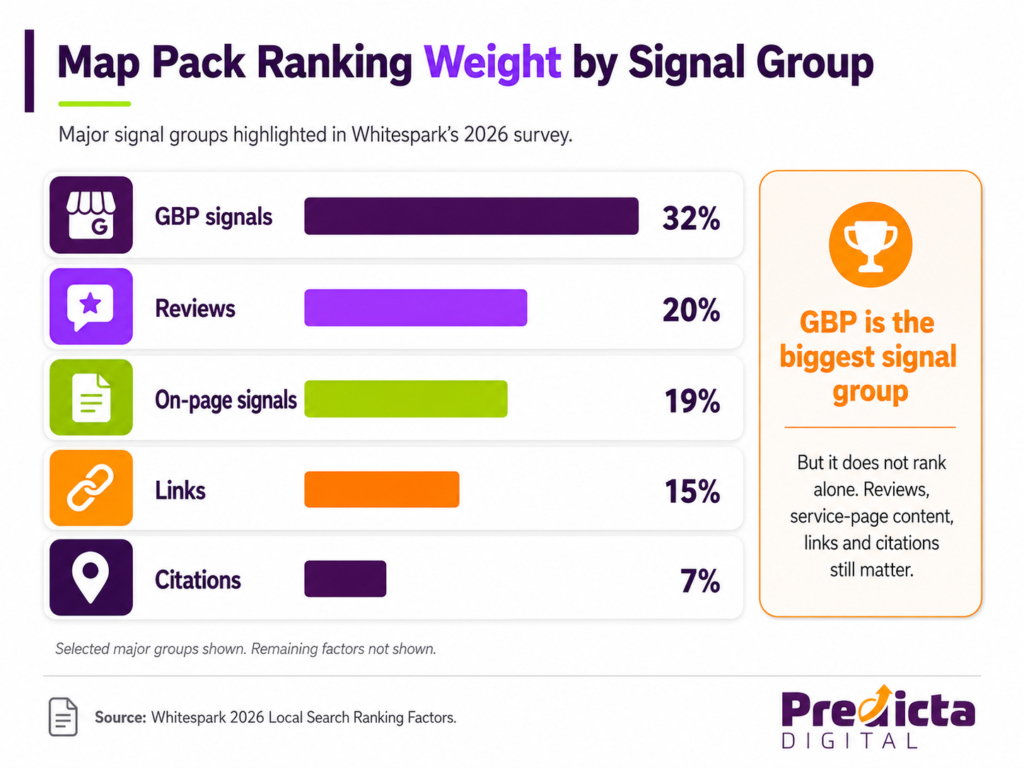
- GBP signals account for 32% of local pack ranking weight, the single largest category, ahead of reviews (20%), on-page signals (19%), and links (15%). Source: Whitespark 2026 Local Search Ranking Factors survey.
- Whether a business is marked open at the moment someone searches is the 5th most important individual factor in Map Pack visibility. Source: Whitespark, 2026 survey.
- A hidden address for service-area businesses is specifically the 7th most influential local ranking factor, and hiding it causes Google to either revert the ranking radius to the business’s original verified location or attach it to an arbitrary point on the map. Source: Whitespark, Darren Shaw.
- An older but still useful Sterling Sky study, tracking 441 keywords over nine weeks of consistent Google Business Profile posts, didn’t find a clear ranking shift tied to the posts themselves, a pattern that roughly matches what we see across the accounts we manage today. Source: Sterling Sky, sterlingsky.ca.
- Adding a specific service to a Google Business Profile’s services list has been observed to shift rankings within 24 to 72 hours in Sterling Sky’s testing, and the services list itself jumped sharply in importance in the 2026 Whitespark survey. Source: Sterling Sky; Whitespark 2026.
Your GBP Category Choice Matters More Than Almost Anything Else You Can Control
Whitespark’s 2026 Local Search Ranking Factors survey, 47 experienced local SEO practitioners scoring 187 individual factors, found that the primary category selected on a Google Business Profile is the single highest-weighted relevance factor in the entire ranking system, ahead of reviews, backlinks, and posting frequency. That doesn’t make reviews unimportant. Reviews still matter for trust, conversion, and ranking support, but they’re slower-moving than category, services, and hours.
The practical version: if Google offers a more specific and accurate category in your market, it can materially change which searches your listing is eligible to compete for. For a plumber, that may mean checking whether more specific secondary categories, drainage, gas fitting, hot water, or emergency-related options, are available and accurate for the business, rather than assuming the category picked at setup is still the best fit. For tradies, this is close to a free lever, most businesses picked their category once and never revisited it as Google added more specific options over time. It’s worth checking against the full category list Google currently offers, not the list that existed when the profile was first created.
Being Marked “Open” Right Now Matters More Than Most of Your Review Strategy
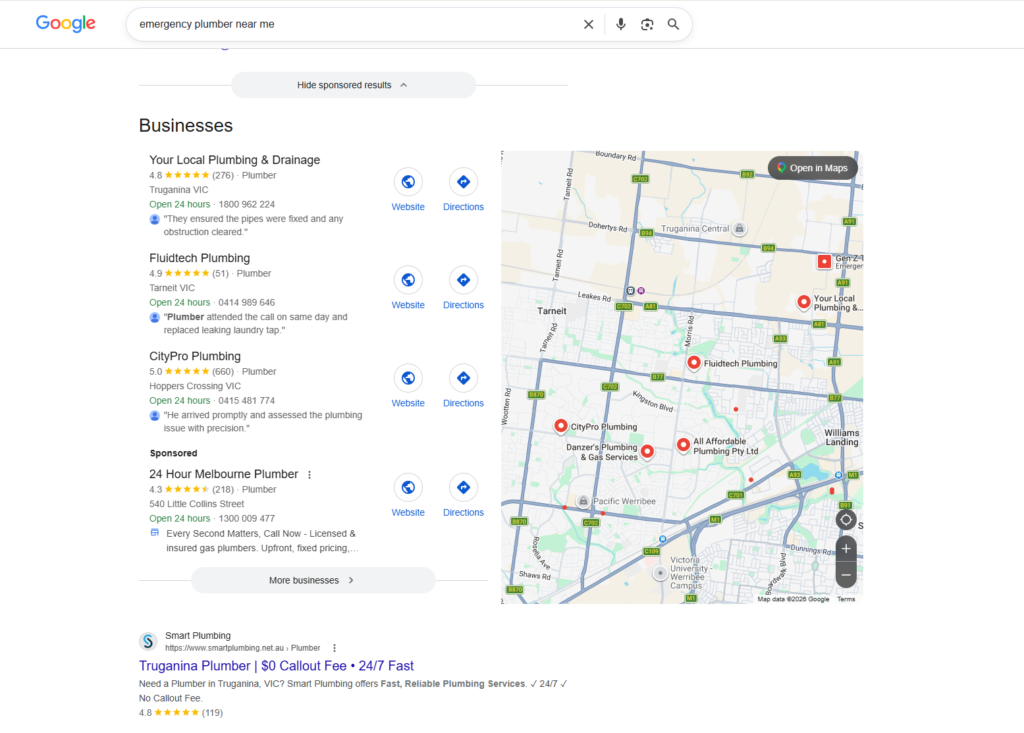
Google Business Profile hours accuracy sits in the top five ranking factors for Map Pack visibility, according to the same 2026 survey, a materially higher position than most business owners would guess. A listing showing as closed at the exact moment someone searches “plumber near me” is being actively deprioritised in that result, regardless of how strong its review count or backlink profile is otherwise.
This matters most for the businesses least likely to have it right: tradies and service businesses with irregular hours, on-call availability, or seasonal changes that never get reflected back into the profile. An electrician taking emergency calls after hours but showing “closed” on their GBP listing is being filtered out of exactly the search where they’d otherwise win.
None of this means marking a business open around the clock regardless of reality. Only mark hours as open if calls are genuinely being answered and jobs can actually be taken during that window.

Google Tells Service Businesses to Hide Their Address. That Advice Has a Real Cost.
Here’s a genuine, acknowledged tension rather than a solved problem. Google’s own guidance instructs service-area businesses, ones that travel to the customer rather than operating from a storefront, to hide their street address from their public listing. Whitespark’s 2026 survey found that a hidden address is specifically the 7th most influential local ranking factor.
Darren Shaw’s own explanation of the mechanism is sharper than the usual version of this story. Hiding the address doesn’t just remove a data point, it does one of two things: if the business has ever moved locations, Google reverts the ranking radius back to wherever the listing was originally verified, which might be an old suburb the business no longer serves. If the business has never moved, Google attaches the ranking radius to an arbitrary point on the map instead.
Neither side of this is wrong exactly. Hiding the address is Google’s safeguard against a business listing a fake or irrelevant storefront just to rank in a suburb it doesn’t serve. But the visibility cost is real and specific, not vague. For a genuine small business operating as a service-area business, the workaround isn’t to fight the hidden-address setting. It’s confirming the profile’s original verification location is still accurate, and leaning harder on the factors that stay fully visible regardless: category specificity and service list completeness. This is especially relevant for NDIS providers and similar service-area businesses that travel to clients rather than operating from a storefront.
The Ugly Ranking Lever You Should Not Copy: Keyword-Stuffed Business Names
There is one ranking factor every tradie has seen in the wild: competitors adding suburbs and services into their Google Business Profile name.
Whitespark’s 2026 survey ranks keywords in the GBP business title as the third strongest individual local pack factor, right behind primary category and proximity. That explains why it still happens.
But this is not a recommendation to rename “Smith Plumbing” to “Smith Plumbing Emergency Plumber Melbourne West.” Google’s own Business Profile guidelines say the business name should reflect the real-world name used on signage, the website, stationery, and by customers. Adding unnecessary information to the business name isn’t permitted, and while outright suspension is rare, Google will often simply strip out whatever isn’t part of the official name.
The practical move isn’t to stuff the name. It’s to put service and suburb signals where they actually belong: categories, services, landing pages, reviews, photos, and citations. If a competitor is clearly breaking the rule and ranking because of it, that’s a spam report to file, not a tactic to copy.
Reviews Still Matter, But Not as a One-Off Review Push
None of this means reviews stopped mattering. They still influence trust, conversion, and ranking support. Whitespark’s 2026 survey weights review signals at around 20% of local pack ranking weight, and factors like positive sentiment in review text and reviews with photos are still active pieces of that picture.
Sterling Sky’s own testing offers two useful data points here, both worth reading with the right caveats attached. An older case study on review count found a small ranking lift for one client’s listing going from nine reviews to ten, with returns diminishing after that. A separate case study on review recency tracked a client through a Google algorithm update and found rankings dropped when a steady flow of new reviews stopped, then recovered once it resumed. Both are single-client observations rather than large controlled studies, and Sterling Sky is upfront about that, but the pattern lines up with what the survey data suggests about recency mattering more than raw total count.
The mistake is treating reviews as the only lever, or running one big review push and then stopping. The better pattern is steady flow. A tradie with 80 old reviews and no recent customer feedback can look stale next to a competitor with fewer total reviews but a consistent stream of recent ones mentioning the actual work completed: blocked drain, switchboard upgrade, hot water repair, roof leak, ducted heating service.
Don’t script keywords into reviews. That’s awkward for customers and risky under Google’s guidelines against incentivised or manipulated reviews. Do ask at the right moment, make it easy, and let customers describe the job honestly in their own words.
The Weekly Post Habit Might Not Be Doing What Most Guides Say It Does
Weekly GBP posts are close to universal advice, and a lot of businesses treat it as their main local SEO lever. An older but still useful Sterling Sky test tracked 441 keywords over nine weeks of consistent weekly posts and didn’t find a clear ranking shift tied to the posting itself. It’s not new research, but it remains a useful counterweight to the common advice, and it roughly matches what we see across the accounts we manage today: the post feature on its own doesn’t seem to be doing the heavy lifting most guides suggest it is.
What we do see track with ranking movement is the profile as a whole staying current, updated photos, corrected hours, services added as they change, questions answered. Whitespark’s 2026 survey weights GBP signals as the single largest local ranking category at 32%, and some of the fastest-rising individual factors inside that category, the services list in particular, are exactly what a genuine profile refresh touches. None of that is the post feature specifically.
So the practical read isn’t “stop posting.” It’s that posting alone isn’t the mechanism worth optimising for. If an hour a week goes into writing a post and nothing else on the profile has changed in months, that hour is probably better spent on the parts of the profile our own client work suggests actually move, services, hours, photos, rather than the post itself.
The Profile Still Needs a Matching Service Page Behind It
A Google Business Profile doesn’t rank in isolation. It points to a website page, and that page helps Google confirm what the business actually does and where it does it.
This is where a lot of tradie profiles lose relevance. The GBP says “emergency plumber,” but the linked website page is a generic homepage with no emergency plumbing section, no service-area copy, no crawlable NAP, and no internal links to a matching service page.
For local SEO in 2026, the profile and the landing page need to say the same thing. If blocked drains, hot water repairs, and emergency plumbing are listed as GBP services, the website needs clear, crawlable sections or pages supporting those services in the suburbs the business actually serves. The same consistency matters beyond the Map Pack too: broader AI SEO work depends on the same alignment between what a profile claims and what the website actually demonstrates, since AI systems checking a business’s credibility look for the same match.
This is usually where the fix stops being a five-minute profile edit and starts being a content and internal linking exercise, a different, slower job than anything else on this list, but it’s the one that makes the rest of the profile work hold up.
What to Actually Do This Week
Review your GBP category against the current full list.
Google adds and splits categories over time. The one selected at setup may no longer be the most specific option available.
Add every distinct service you offer as an explicit GBP service listing, not just a general category.
Sterling Sky’s testing suggests this is one of the faster-moving levers available, with effects observed inside 72 hours, and it’s one of the sharpest risers in the 2026 factor rankings.
Audit your listed hours against your actual availability.
This matters especially if you take emergency, after-hours, or seasonal work that isn’t reflected in the standard hours field.
Treat weekly posts as a communication task, not a ranking task.
Keep posting if it serves customers directly, promotions, real updates, but don’t budget the time as your main SEO lever.
If you’re a service-area business, confirm your original verification location is still correct.
Then focus effort on category specificity and service completeness, since those stay fully visible regardless of the hidden-address setting.
Check rankings on a local grid, not from one laptop in one suburb.
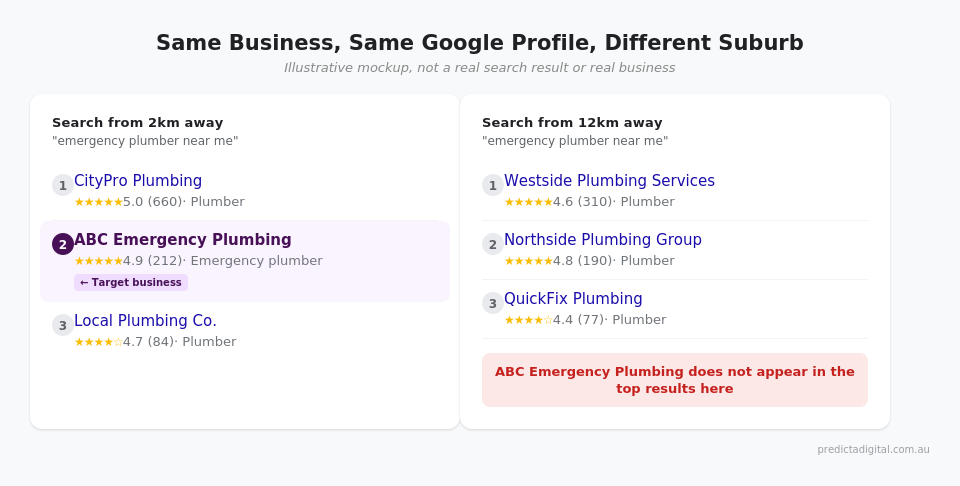
Map Pack visibility changes street by street, especially for tradies. A business can be position two near its verified location and invisible ten kilometres away. Before changing categories, services, or hours, take a grid snapshot so you know whether a change actually improved the service area or only moved one search point. It’s also the honest answer to the plumber from the opening: if he’s only ever checked his own ranking from his own laptop, position four might be accurate for his own suburb and a serious underestimate everywhere else he serves.
All of this sits alongside the broader SEO services in Melbourne we build for tradies and local service businesses across the city.
Frequently Asked Questions
Do Google Business Profile posts help my ranking?
An older but still useful Sterling Sky study tracking 441 keywords across nine weeks of consistent posting didn’t find a clear ranking shift tied to the posts themselves, and that broadly matches what we see across the accounts we manage today. Posts may still be worth doing for customer communication, but they shouldn’t be treated as the main ranking lever.
What’s the single most important Google Business Profile factor in 2026?
According to Whitespark’s 2026 survey of 47 local SEO practitioners, GBP primary category specificity is the highest-weighted individual relevance factor, ahead of reviews, backlinks, and posting activity.
Should service-area businesses show their address?
Google’s guidance says to hide it, and that’s the correct setting for a genuine service-area business. The trade-off is a documented, specific visibility cost, a hidden address is the 7th most influential local ranking factor, which is why category specificity and complete service listings matter more for these businesses than for storefront businesses.
How fast can a Google Business Profile change affect ranking?
Sterling Sky’s testing has observed ranking shifts within 24 to 72 hours after adding a new service listing, one of the faster-acting changes available compared with reviews or backlinks, which typically build impact more gradually.
Want a clear read on where your listing actually stands in the Map Pack?
Get a Local SEO Audit