
Why Your Business Doesn’t Show Up When Customers Ask ChatGPT
A client asked me last month whether their SEO was working, because a customer told them they’d asked ChatGPT for a recommendation and the business didn’t come up. Their Google rankings were fine. Their traffic was up. But in that particular moment, when a buyer asked an AI assistant for a shortlist, they weren’t on it.
The reason isn’t what most people assume. It’s not that ChatGPT dislikes their content or that their authority is too low. It’s that ChatGPT doesn’t operate the way Google does, and the two systems select pages for completely different reasons.
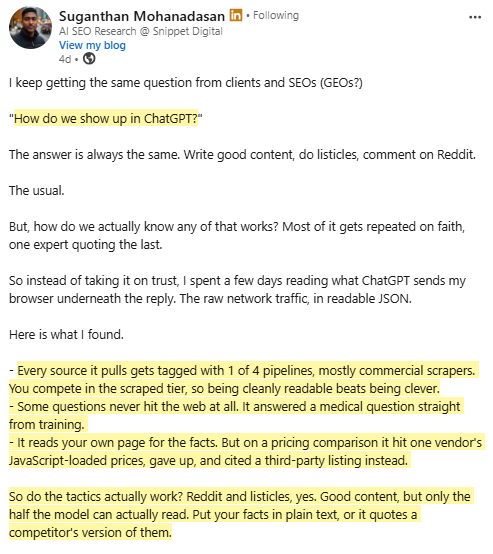
Suganthan Mohanadasan, co-founder of Snippet Digital, spent several days reading the raw network traffic that ChatGPT sends to his browser underneath a reply. His analysis — published on Search Engine Journal in June 2026 — is the most direct look at the mechanism I’ve seen, and it changed how I think about AI search visibility for clients.
In that June 2026 analysis, Mohanadasan identified four recurring source labels in the traffic: serp, labrador, bright, and oxylabs. His findings suggest ChatGPT can route different query types through different retrieval providers and source pools. This was an observational analysis of one researcher’s specific sample, not official documentation of ChatGPT’s complete architecture, and the labels may not mean the same thing for every user, model version, or query type. But the pattern is consistent enough to be worth understanding.
The Ahrefs team ran a separate study across 1.4 million ChatGPT prompts from February 2025 and found that even when ChatGPT does retrieve a page, it only cites roughly half of what it reads. Showing up in the retrieval pool isn’t enough. The page still has to pass a second filter.
What follows is the mechanism, built from both of those studies. Understanding it is the first step to knowing what to actually fix.
KEY FINDINGS
- In one researcher’s traffic analysis, ChatGPT appeared to route queries through four recurring source labels: open web search, a licensed publisher tier (Reuters, Guardian, Wikipedia), and two commercial scrapers (Bright Data and Oxylabs). For commercial and local queries in his sample, the scraped tier did most of the work. Source: Suganthan Mohanadasan, network traffic analysis, June 2026. Observational, not official documentation.
- 88% of URLs ChatGPT cites come from search results. The rest come from news, Reddit, YouTube, and academic sources combined. Source: Ahrefs, April 2026, 1.4 million prompts.
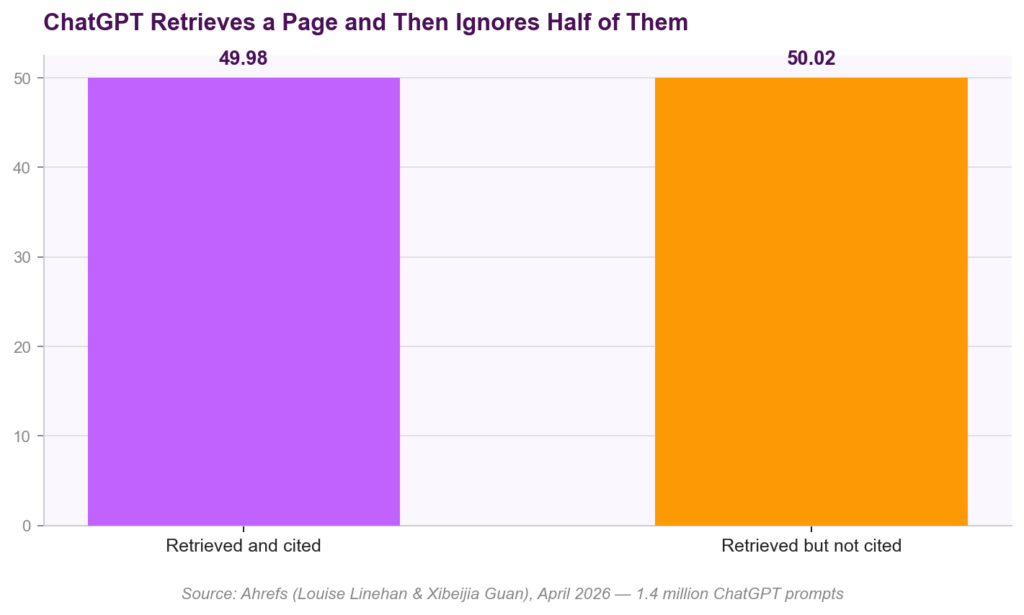
- ChatGPT cites only 49.98% of URLs it retrieves. Half of what it reads, it discards. Retrieval is not citation. Source: Ahrefs, April 2026.
- Reddit was retrieved 278 times in Mohanadasan’s sample and cited just 11 times. YouTube was retrieved 201 times and cited zero. Source: Suganthan Mohanadasan, June 2026.
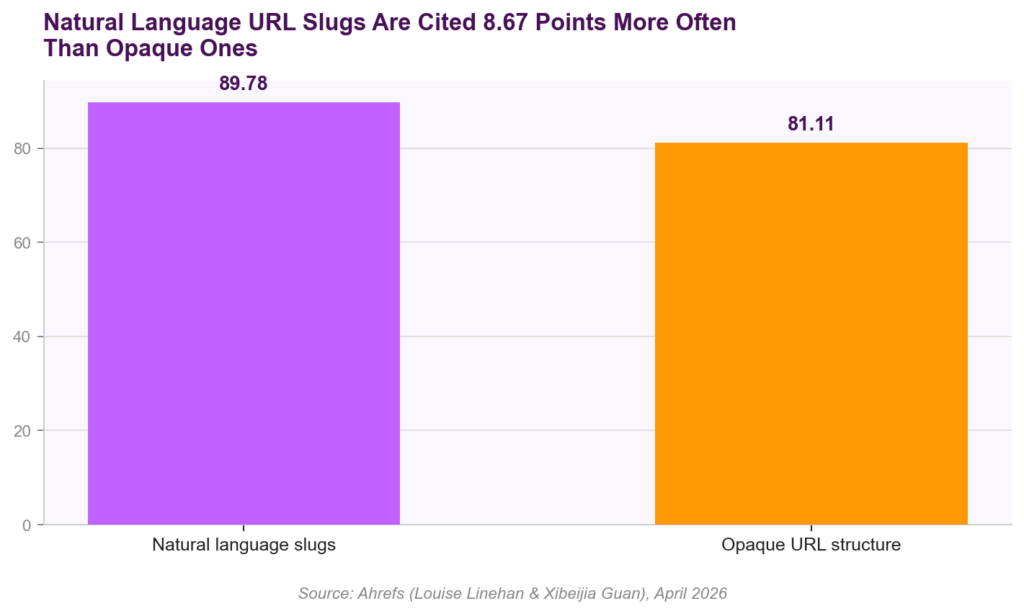
- Pages with natural language URL slugs are cited at 89.78% versus 81.11% for opaque URLs — an 8.67 percentage point association. Source: Ahrefs, April 2026.
- The median cited page is approximately 500 days old (~1.3 years). New content rarely makes the cut. Source: Ahrefs, April 2026.
- When ChatGPT encounters JavaScript-rendered pricing pages it can’t parse, it cites a competitor’s review site instead. Source: Suganthan Mohanadasan, June 2026.
- Approximately 30% of current-event queries bypass live search entirely and are answered from training data. Source: Suganthan Mohanadasan, June 2026.
ChatGPT Doesn’t Run One Search. It May Run Several, Depending on the Query.
When someone asks ChatGPT a question, the model doesn’t do a single web search. It classifies the query and routes it through one or more source pipelines, each with different content and different selection logic.
The four labels Mohanadasan observed: serp (the open web search baseline, returning news sites and general results), labrador (a licensed publisher tier that included Reuters, the Guardian, the Financial Times, Wikipedia, and arXiv, with roughly 1,080-character snippets), bright (Bright Data, a commercial web scraper that appeared on shopping, finance, and commercial queries in his sample), and oxylabs (Oxylabs, a competing scraper that appeared on regional and local press queries). Other independent researchers tracking AI crawler behaviour have reported similar provider-routing patterns, which is one reason this is worth taking seriously even without OpenAI confirming it.
If you run a service business in Australia asking why you’re not in ChatGPT, this is a plausible part of the answer for commercial and local queries specifically: the model may not be reading what’s indexed in Google at all for that query type. It may be reading a scraped version of the web instead. What matters either way is the same thing — whether your page can actually be read by whatever is doing the fetching.
88% of What ChatGPT Cites Comes From Search. Reddit Gets Fetched and Discarded.
The Ahrefs study put hard numbers on what Mohanadasan’s traffic analysis showed structurally. Across 1.4 million prompts, 88% of URLs ChatGPT cited came from search results. News sources contributed 12%. Reddit, despite being retrieved millions of times, was cited at just 1.93%. YouTube: 0.51%. Academic sources: 0.40%.
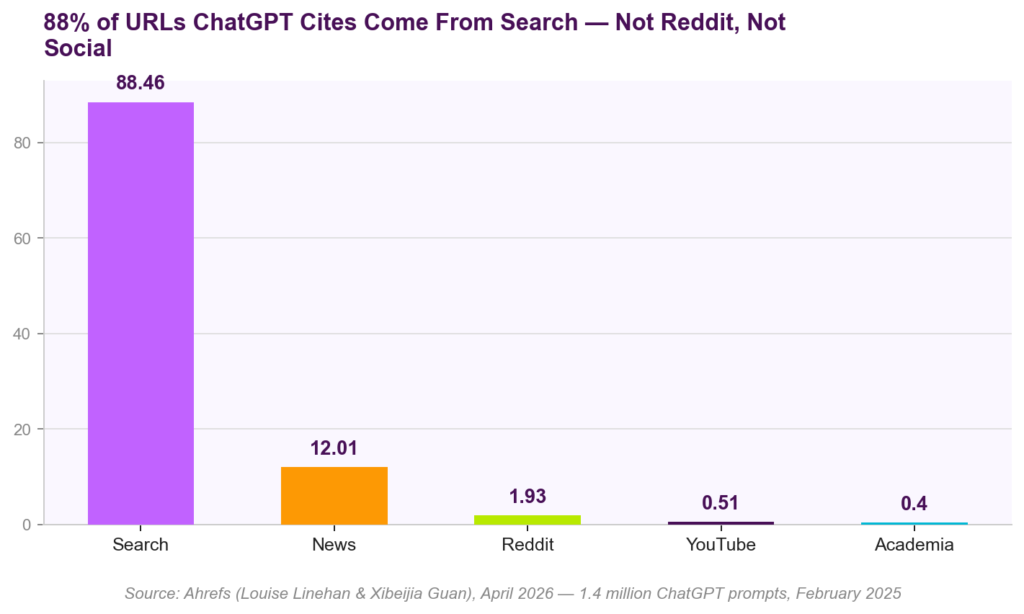
The Reddit data is striking when you cross it with Mohanadasan’s traffic logs. ChatGPT retrieved Reddit 278 times in his sample. It cited Reddit 11 times. YouTube was retrieved 201 times and cited zero times. The data supports two things clearly: Reddit gets retrieved more often than it gets cited, and across both measured datasets it was rarely cited outright. It doesn’t prove why, and the “structured fact-claims” explanation is a reasonable guess rather than something either study directly measured.
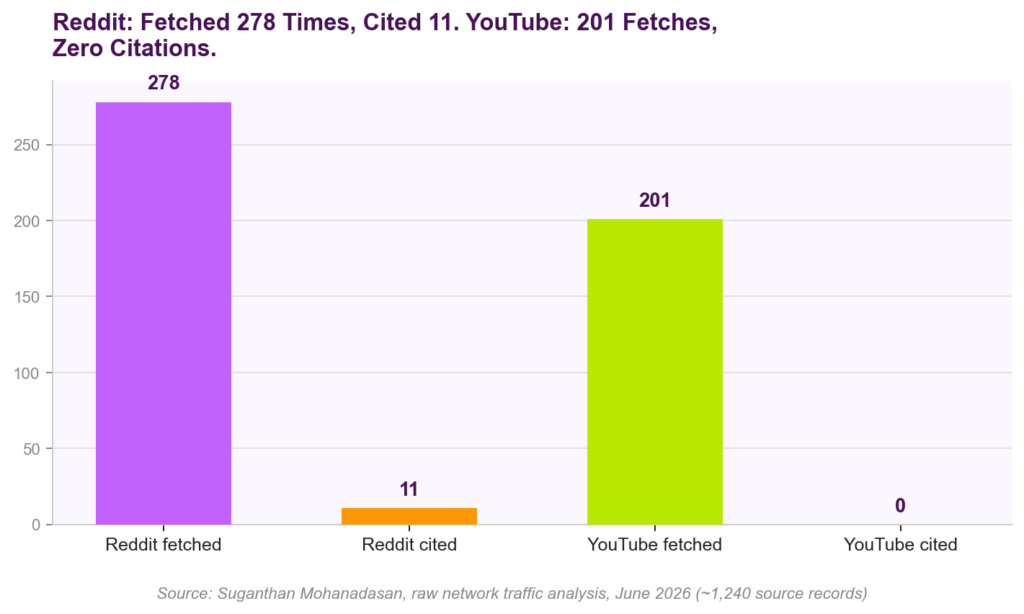
The implication for the standard advice — “get your brand mentioned on Reddit” — is that Reddit may influence the information available during retrieval even when it never shows up as a visible citation. That makes its role different from a directly cited source, but the available data doesn’t establish how much an individual brand mention actually contributes. It’s a reasonable bet that forum mentions help retrieval more than they help citation, not a proven mechanism.
ChatGPT Cites Only About Half of the Pages It Retrieves
This is the part of the mechanism that most businesses don’t account for. Getting into the retrieval pool is not the same as getting cited. The Ahrefs study found that ChatGPT retrieved pages and cited approximately 49.98% of them, and did not cite the other 50.02%. Half of what it reads, it drops.
The differentiator between cited and not-cited is relevance, not freshness. Ahrefs measured this using cosine similarity between the prompt and the page title. Cited URLs had a score of 0.602; non-cited had 0.484. The model runs internal “fanout queries” — sub-questions generated from the original prompt — and the best-matching title in that set scored 0.656. Pages that match the sub-question closely, not just the headline query, are the ones that get through.
New Pages Don’t Make the Cut. The Median Cited Page Is Over a Year Old.
The Ahrefs data on content age runs counter to the instinct to publish frequently and optimise for freshness. Across 1.4 million prompts, the median page that ChatGPT cited was approximately 500 days old, roughly 1.3 years. The oldest cited pages were over 2,700 days old — more than 7 years. Non-cited pages skewed significantly younger.
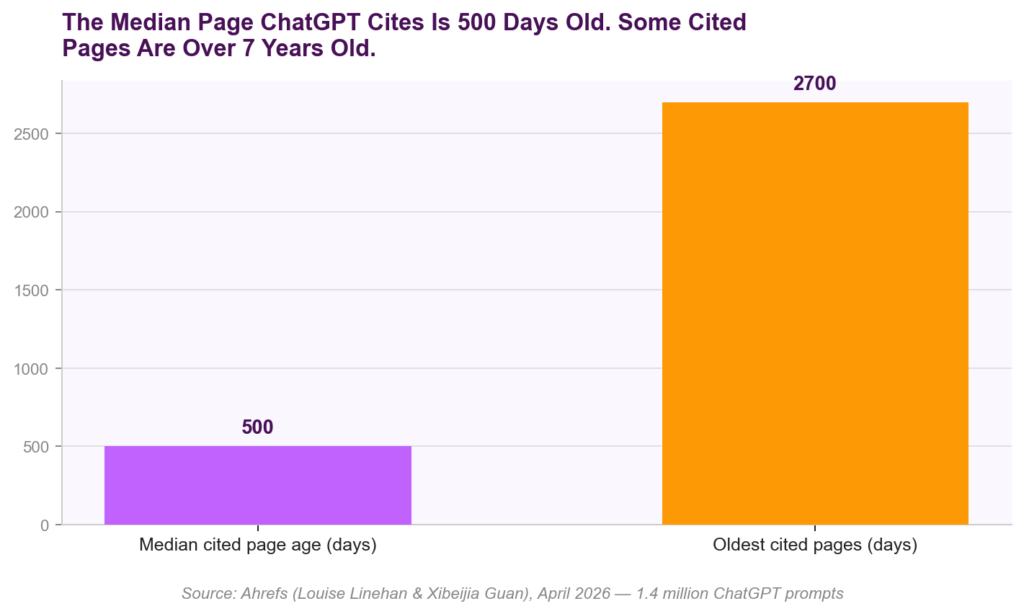
One plausible explanation is trust accumulation: older pages have had more time to earn links, mentions, and repeated retrieval, and the model may weight that history when deciding what’s worth citing. But the age data alone doesn’t prove that’s the mechanism. Older pages also differ in other ways — authority, crawl history, content depth, link profile — that could explain the gap just as well. What the data does support is this: new content competes on a longer timeline than most businesses plan for, whatever the exact cause turns out to be.
URL Structure and Title Relevance Both Move the Citation Rate
The Ahrefs study found two specific technical signals associated with citation-rate differences. URL structure is the simpler one: pages with natural-language URL slugs (the kind that read as a phrase or question) were cited at 89.78%, versus 81.11% for opaque URL patterns with ID numbers, parameters, or random strings — an 8.67 percentage point association. That doesn’t prove rewriting a slug alone produces the same uplift. Readable URLs tend to come with other things — better titles, cleaner site architecture, newer CMS platforms — that could be doing some of the work. But it supports using descriptive, stable URLs as part of a broader retrieval-friendly structure, not as a standalone fix.
Title relevance is the harder one. The model scores each retrieved page’s title against both the original prompt and the internally-generated fanout queries. Pages with titles that match the sub-question — not just the headline — have higher citation rates. “SEO services Melbourne” is less specific than “Local SEO for Melbourne trade businesses” for a query about trade businesses specifically. The more precisely the title matches what the model is actually looking for, the better.
What Service Businesses in Australia Should Actually Do
The mechanism above points to specific, concrete fixes — not a content overhaul, but targeted changes to how your pages are built and how your business exists outside your own site. This applies whether you’re running SEO in Melbourne, Geelong, or anywhere else in Australia.
Put your facts in plain HTML text. Pricing, service inclusions, locations served, hours, team credentials, certifications. If it matters to a buyer, it should be in crawlable text. JavaScript-rendered data is a citation gap. We covered how to check this in detail in Is Your Website Visible to AI Agents? This is the highest-priority technical fix for most businesses.
Clean up your URL structure. If your service pages are sitting at URLs like /services?id=142 or /page/47, migrate them to descriptive paths. The 8.67 percentage point association with citation rate is real, and the fix is a redirect map and slug rewrite, not a content project.
Build third-party mentions on pages that are already indexed and trusted. Industry directories, supplier pages, local press, review platforms, professional bodies. These are the kind of external signals associated with older, more-cited pages in the research above. The goal is to appear in sources that already look credible to whatever is doing the fetching — not to chase one specific provider.
Don’t rely on Reddit mentions alone for citations. A Reddit discussion mentioning your business may shape what the model knows about your category, but the data from both studies shows it’s rarely what gets directly cited. Treat it as one input among several, not a citation strategy on its own.
Write pages that answer the sub-questions, not just the headline. Think about what follow-on questions a buyer might ask after their initial question. A page titled “What does an SEO audit include” will match ChatGPT’s fanout queries on pricing, timeframes, and deliverables differently than a page titled simply “SEO audits.” The title and the content should map to the complete question cluster, not just the entry point.
Plan for the age gap rather than fighting it. New pages compete on a longer timeline, whatever the exact mechanism turns out to be. If you’re tracking whether your pages are being cited at all, our comparison of Ahrefs, Semrush, and SE Ranking for AI visibility tracking covers the tools that measure this. The practical counter is to publish on domains that already have age and authority — guest posts, directory profiles, industry publication features — and use those to direct citation attention back to your site while your own pages build their own history.
The AI Citation Funnel
Pull the mechanism together and it works like a funnel, not a single gate. Your page has to clear each stage to reach a buyer’s screen.
Retrieved. The model’s source pipeline has to fetch your page at all. If your facts are locked behind JavaScript rendering, this stage can fail silently — the page gets fetched but the content underneath isn’t readable.
Cited. Roughly half of what gets retrieved is cited, per the Ahrefs data. Title relevance to the model’s internal sub-questions and a readable URL structure are both associated with clearing this stage, though neither one is a guarantee on its own.
Trusted enough to lead with. Older pages and pages with more external mentions show up more often in the citation data. The likely reason is accumulated trust signals, though that’s a plausible explanation rather than a directly proven mechanism.
Named, not just linked. Even a citation doesn’t guarantee the model says your business name in the answer text rather than just linking to your page. That’s a separate, harder problem — and one worth checking for directly rather than assuming it follows automatically from the first three stages.
A Quick Way to Check Where You Actually Stand
Before assuming any of this applies to your business specifically, it’s worth checking the basics directly.
Has a customer ever mentioned asking ChatGPT or another AI assistant about your industry and not finding you? That’s the first real signal — more reliable than any general industry statistic.
Open your own pricing, booking, or service-detail pages with JavaScript disabled. If the key facts disappear, an AI crawler may be seeing the same blank page.
Check your URL structure for service pages. IDs, parameters, and random strings versus descriptive, readable paths.
Search your own business name plus your service in ChatGPT or Perplexity. See whether you’re named directly, cited as a link only, or absent entirely. Those are three different problems with three different fixes.
None of this tells you definitively why a specific result happened — the underlying mechanism is still being reverse-engineered by researchers outside the platforms themselves. But it tells you which stage of the funnel is worth investigating first, rather than guessing.
The gap between ranking well on Google and getting cited by ChatGPT is structural, not a content quality gap on its own. The two systems select pages using different criteria from different source pools, and large parts of that mechanism are still being mapped by independent researchers rather than documented by the platforms themselves. What the available evidence does support is specific and actionable: plain-text data where it currently isn’t, descriptive URLs, and a clearer read on where your own pages actually sit in the funnel above.
Want to know exactly where your business sits in the AI citation funnel — and what to fix first?
Get an AI Visibility AuditOr learn more about Generative Engine Optimisation (GEO)