
Semrush vs Ahrefs vs SE Ranking for AI Visibility: Which Tool Should Your Agency Actually Use in 2026?
Most SEO tool comparisons in 2026 tell you the same thing: all three platforms have AI visibility features now, here are the pricing tables, here is who wins on features. That is not useful if you are trying to make an actual platform decision under real budget and client constraints.
This comparison is written from Predicta Digital’s direct use context as a local SEO agency managing Melbourne service business clients. The verdict is opinionated. The pricing is in AUD. The case studies are from real agencies. And the weighted criteria table at the end makes the reasoning traceable — so you can see why the verdict lands where it does, and adjust it for your own situation.
| Before we go further, one framing note that most comparisons skip: AI visibility data from all three platforms is tracking a moving target. AI search outputs vary by model version, query phrasing, user context, and time of day. SE Ranking’s own research found Google AI Mode overlaps with itself only 9.2% of the time across repeated runs of the same query. Use these tools to identify trends and gaps, not to produce precise scores. That said, the gaps they reveal are real and commercially meaningful — as the case studies below show. |
First: What Does ‘AI Visibility’ Actually Mean?
The phrase ‘AI visibility’ appears in marketing for all three platforms, but they are not all measuring the same thing. Before comparing tools, it helps to be precise about what each type of measurement actually tells you.
| Measurement Type | What It Tracks | Which Tools Offer It | What It’s Good For |
| Brand mentions | Whether your brand name appears in AI-generated responses, with or without a link | Ahrefs Brand Radar, Semrush AI Toolkit, SE Ranking AI Results Tracker | Brand awareness in AI responses; catching hallucinations or misrepresentations |
| Citations / source links | Whether AI systems link to your specific pages as sources in their answers | Semrush AI Toolkit, SE Ranking (citation URLs in Results Tracker) | Understanding which content AI systems treat as authoritative; optimising citable pages |
| Prompt / topic tracking | Whether you appear when specific questions are asked across AI platforms | Semrush Prompt Research + Tracking, SE Ranking AI Overviews Tracker | Finding where competitors are cited but you are not; building a content gap plan |
| AI Overviews presence | Whether your pages appear as sources in Google AI Overviews for specific keywords | Semrush, SE Ranking AI Overviews Tracker, Ahrefs (within Brand Radar) | Keyword-level reporting on AI Overviews presence; closest to traditional rank tracking |
| Share of voice | Your brand’s proportional presence in AI responses versus competitors across a topic category | Semrush Brand Performance, Ahrefs Brand Radar, SE Visible | Competitive positioning; understanding who ‘owns’ a category in AI responses |
Most agencies start by wanting to know ‘where does my client appear in AI?’ — which is a brand mentions question. The more commercially useful question is usually prompt-level: ‘which questions is my client’s competitor being cited for that my client is not?’ That gap becomes a content brief. Only Semrush and SE Ranking can answer that question with any depth.
The deeper point: tracking AI visibility and optimising for it are different disciplines. The technical foundations of GEO — entity clarity, schema markup, structured content, llms.txt — determine whether you appear in AI responses at all. The tools in this comparison measure that performance. They do not create it.
How This Comparison Was Built
This comparison draws on Predicta Digital’s direct use of SE Ranking and Ahrefs across Melbourne agency workflows, testing of Semrush’s AI Visibility Toolkit, and independent third-party reviews published in 2025–2026 from EWR Digital, Rankability, Dageno AI, and Superlines. Where vendor-published case studies are cited, they are attributed and used as evidence of what the tool can do — not as proof of typical results.
We are not neutral. SE Ranking is our primary operational platform and Ahrefs is our research tool. That combination reflects a deliberate decision for our agency model — one that may not fit yours. The criteria table below is designed to help you apply the same framework to your own situation.
The Weighted Criteria: Why the Verdict Lands Where It Does
The four criteria that determine platform fit for a Melbourne local SEO agency, weighted by commercial importance:
| Criterion (weight) | Why It Matters | Ahrefs | Semrush | SE Ranking |
| Local SEO capability(Weight: High — core deliverable for service biz clients) | Map Pack tracking and suburb-level rank data are the primary proof of results for local clients. A tool that cannot do this requires a paid supplement. | Fail — no Map Pack tracking. Needs BrightLocal or equivalent add-on | Pass — best toolkit, but $41–$83 AUD/location/mo is prohibitive at scale | Pass — Grid Rank Tracker included. Extra locations ~A$25/mo each |
| AI visibility tracking(Weight: High — fastest-growing new reporting obligation) | 45% of consumers now use AI for local business recommendations (BrightLocal 2026). Agencies that cannot report on this are reporting on half the channel. | Partial — brand-level only, no prompt tracking, documented accuracy gap on ChatGPT | Pass — most complete: brand mentions + citations + prompt tracking + sentiment | Pass — six platforms, integrated with rank data, honest about volatility. MCP Server available (as is Ahrefs MCP). Semrush has no MCP. |
| Backlink and keyword data depth(Weight: Medium — important for competitive and link work) | Deep backlink analysis and large keyword databases matter for competitive SEO. Less critical for local keyword sets, which are smaller and more defined. | Best — industry benchmark for backlinks. 35 trillion link index. | Strong — largest keyword DB (27+ billion), 51 trillion backlinks (2026), best intent classification | Adequate for local — smaller databases (~2.9T links, ~5–7B keywords) limit deep competitive work |
| Cost per client at scale(Weight: High — determines margin at 5–15 client volumes) | Add-ons compound fast. A tool that is cheap at one client can become the largest line item by ten clients. | Fails at scale — $828–$1,148 USD/mo minimum for full AI coverage. Per-domain pricing makes multi-client use cost-prohibitive. | Fails at scale — $1,117 AUD/mo for realistic agency scenario. Per-location local cost explodes with client count. | Wins — ~A$589/mo for full agency scenario with AI visibility + local + 3 users |
| Verdict based on weighted criteria: For agencies where local SEO is the core service and AI visibility is an emerging reporting obligation, SE Ranking wins on three of four criteria. Ahrefs wins on backlink depth but fails on local and cost per client. Semrush wins on AI visibility feature depth but fails on cost at scale and now carries Adobe acquisition risk. The multi-tool recommendation — SE Ranking operationally + Ahrefs for deep research — covers all four criteria without either platform’s key weakness. |
AI Visibility Tracking: What Each Platform Actually Does
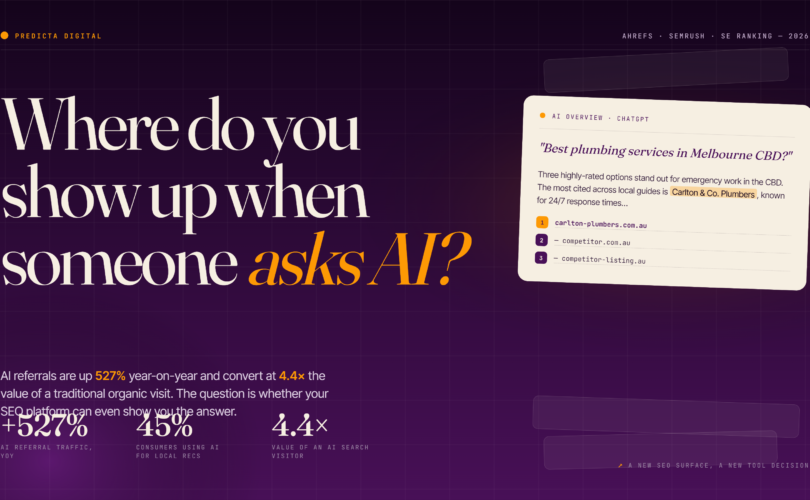
AI referral traffic grew 527% year-on-year in 2025 according to Search Engine Land’s Previsible AI Traffic Report. Superlines’ March 2026 AI search statistics compilation found that citation volumes for the same brand can differ by 615x between platforms — Grok versus Claude, for example. That variance alone makes single-platform tracking misleading.
Ahrefs Brand Radar: Research-Grade Data, Real Accuracy Issues
Ahrefs draws from 200 million+ monthly search-backed prompts across six AI platforms. The research value is genuine: In a study of 75,000 brands, Ahrefs found the three strongest correlations with AI Overview visibility are all off-site signals: branded web mentions (0.664) — the single strongest predictor, with top-quartile brands earning up to 10x more AI citations than the next quartile — branded anchors (0.527), and branded search volume (0.392). Their December 2025 follow-up study also found YouTube mentions now outperform web mentions as the single strongest predictor across ChatGPT, AI Overviews, and AI Mode combined — an original and commercially actionable finding.
The accuracy problem is also real and documented. Ahrefs uses a keyword-first snapshot methodology rather than prompt-level tracking — it records which brands appear in responses to queries from its existing search database, at timed intervals, rather than monitoring live prompts continuously.
| Independent testing published by Dageno AI in April 2026 found Brand Radar reported 3 ChatGPT mentions for a tested brand globally versus an actual manually-counted figure of 123 — a 97.5% undercount. Google AI Overviews tracking was more accurate but still imprecise. The conclusion from EWR Digital’s agency testing: ‘Brand Radar feels like a legacy SEO framework forced into an AI-shaped mold.’ At $828–$1,148 USD/mo minimum for full six-platform coverage, it is a niche solution for brands with large budgets and in-house data science teams — not a scalable agency tool. |
| Best for: strategic brand research and directional AI share-of-voice analysis. Not for: operational client reporting or agencies managing more than two or three clients on AI tracking. |
Semrush AI Visibility Toolkit: Most Actionable, Real Agency Results, Adobe Caveat
Semrush has published the most transparent research on its own AI tracking methodology. Its analysis of 10 million keywords found AI Overviews peaked at 24.6% of Google results in 2025 before pulling back — and that zero-click rates for keywords with AI Overviews have actually been declining since January 2025, which is a useful counter-narrative to AI panic. The Semrush AI Visibility Index measures share of voice by factoring in both mention frequency and prompt volume, updated in October 2025 to reflect how often prompts are actually searched.
What separates Semrush from the other two on AI visibility is Prompt Research: it functions as keyword research for AI queries, showing which questions users are asking AI platforms in your category, the relative volume of those prompts, and where competitors are appearing that you are not. That gap analysis becomes a direct content brief. Neither Ahrefs nor SE Ranking offers this.
| Sure Oak, a US agency, used Semrush’s AI Visibility Toolkit as their own proof of concept: they boosted their appearance in AI Overviews by 286% and grew ChatGPT referral visits by 41%. 40% of all new agency leads now come from AI visibility. Separately, Coalition Technologies used the toolkit’s sentiment tracking to identify that ChatGPT was reportedly calling their client Army Surplus World’s products ‘outdated technology’ — a hallucination, as reported in Semrush’s published agency case study. They corrected it by refreshing messaging on the client’s homepage, about page, and social profiles. The brand visibility and sentiment score made the problem measurable before anyone noticed it manually. For a cybersecurity client, the same integrated approach produced a 137% year-on-year increase in conversions alongside a 429% increase in AI referral traffic. |
The Adobe factor: Adobe completed the $1.9 billion acquisition of Semrush on April 28, 2026. Semrush now operates as ‘Semrush, an Adobe company’. Adobe’s acquisition of Magento and Marketo in 2018 followed a pattern of 12–24 months of normal operations before enterprise integration shifted pricing structures. For SMB-focused agencies, that trajectory warrants caution on multi-year Semrush commitments.
| Best for: agencies whose clients need deep AI visibility reporting — prompt-level gap analysis, sentiment tracking, competitor benchmarking across platforms. Most powerful when AI visibility is not just a reporting metric but an active strategy. Cost and Adobe risk are the limiting factors for SMB agency models. |
SE Ranking: Integrated, Honest About Limitations, Best Value
SE Ranking’s most credible differentiator is its own published research. A study of 2.3 million pages found that high-traffic sites earn 3x more AI citations than low-traffic ones, with domain traffic as the strongest predictor (SHAP value: 0.63). That is not a tool feature — it is a finding that helps agencies prioritise authority-building for clients who want AI citation gains.
The AI Results Tracker covers six platforms — Google AI Overviews, Google AI Mode, ChatGPT, ChatGPT Search, Gemini, and Perplexity — and integrates alongside keyword rank tracking in the same dashboard. For monthly client reporting, that integration matters: organic position and AI citation presence in one view, rather than two separate tools producing numbers that do not connect.
SE Ranking’s AI Mode research is the most specific data on volatility published by any of the three platforms: AI Mode overlapped with itself only 9.2% of the time across three consecutive runs of the same query. That number is useful precisely because it sets the right expectation for clients — AI visibility is a trend signal, not a position number.
| Both Ahrefs and SE Ranking have launched official MCP Servers, enabling direct connection to Claude, ChatGPT, and other AI assistants for code-free SEO workflows. Ahrefs launched its remote MCP Server first, in mid-2025, available on all paid plans from Lite upward — connecting AI agents to its backlink, keyword, and competitive analysis data. SE Ranking followed later in 2025 with its own MCP Server, covering rank tracking, local SEO, and AI visibility data. Semrush has no native MCP Server as of May 2026 — a genuine gap for agencies building agentic SEO processes. |
| Best for: agencies managing multiple local clients who need integrated AI visibility + rank tracking + local SEO at a cost that works at SMB scale. The honest limitation: smaller databases mean deep competitive link work requires Ahrefs as a supplement. |
Local SEO: The Dimension That Decides the Comparison for Melbourne Agencies
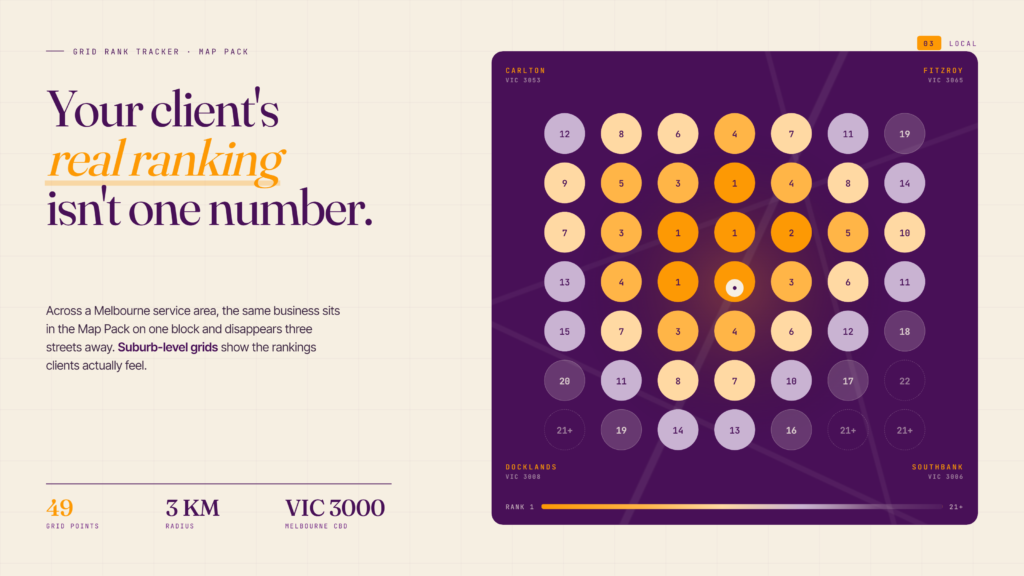
For agencies managing Melbourne service businesses, local SEO tool capability is the highest-weight criterion in the decision. Map Pack visibility and suburb-level rank tracking are the primary deliverable — not a secondary feature.
| Capability | Ahrefs | Semrush | SE Ranking |
| Map Pack / Local Pack tracking | ❌ Not available at any price | ✅ Heatmap grid($41–$83 AUD/location/mo) | ✅ Grid Rank Tracker(3 included, ~A$25/mo extra) |
| GBP management | ⚠️ Monitor only | ✅ Full management suite | ✅ Post scheduling + monitoring |
| Review management | ❌ Not available | ✅ AI-powered review replies | ✅ AI sentiment analysis |
| Listing management | ❌ Not available | 70+ directories | 100+ directories |
| Cost: 8 Melbourne suburbs(1 client, annual billing) | Not possible | ~A$331–A$662/mo | ~A$102/mo (5 extra locations) |
Ahrefs is absent from the local tracking table because it has no Map Pack capability. Any agency whose primary service is local SEO must supplement Ahrefs with BrightLocal, Local Falcon, or Whitespark — adding both cost and operational complexity.
The per-location cost gap between Semrush and SE Ranking is the single most significant practical difference in this comparison at Melbourne agency scale. An agency managing ten clients across five Melbourne suburbs each is looking at approximately A$2,070–A$4,140/month in Semrush local tracking costs alone. The equivalent SE Ranking cost is approximately A$510/month.
What Each Platform Actually Costs an Australian Agency
| Currency note: All prices USD with AUD equivalent in brackets. Rate: 1 USD ≈ A$1.38 (mid-market, May 7 2026). AUD figures are indicative — verify before budgeting. |
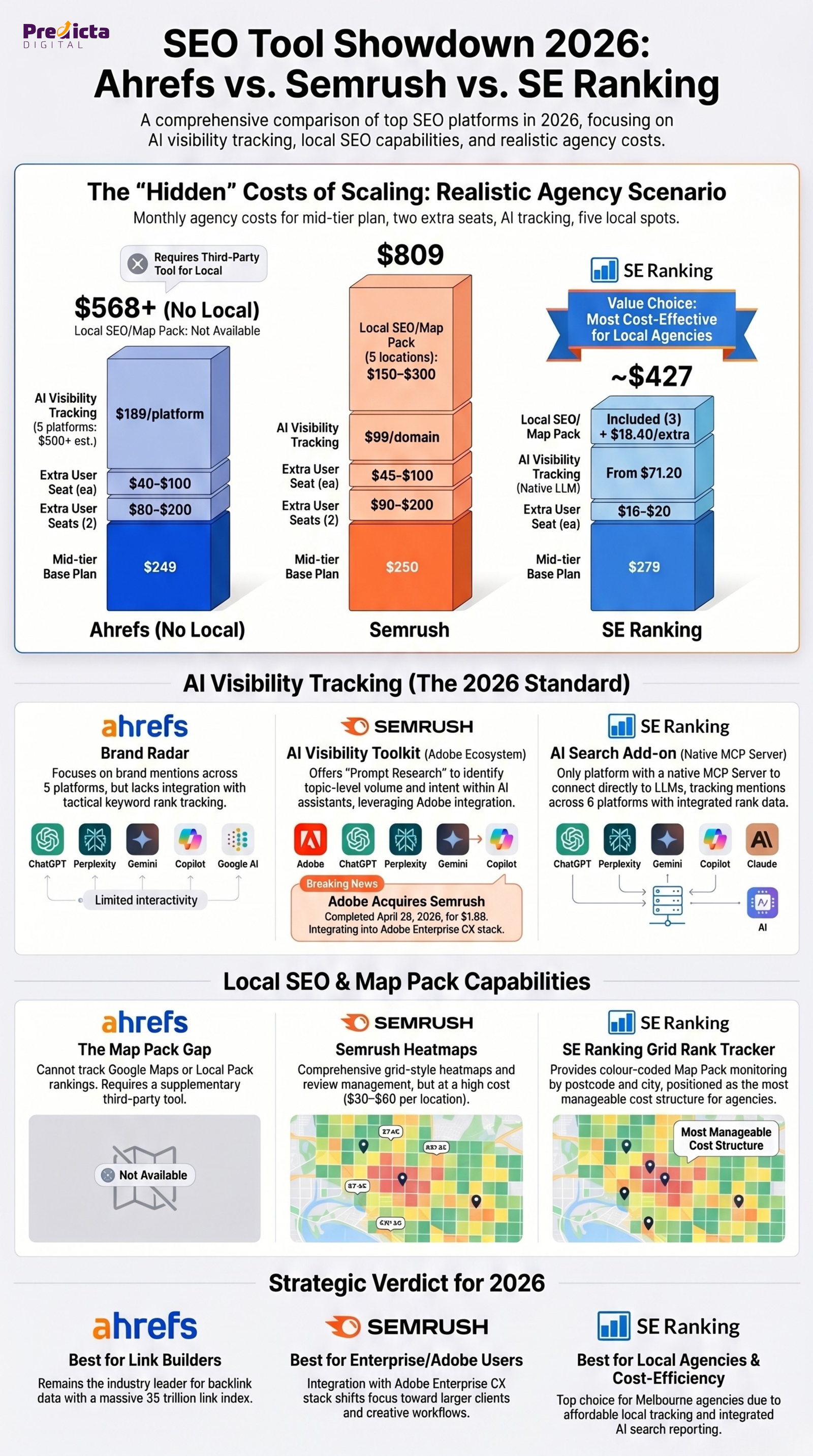
Realistic Agency Scenario: Mid-tier Plan + 3 Users + AI Visibility + 5 Local Locations
| Ahrefs | Semrush | SE Ranking | |
| Mid-tier base/mo | $249 USD (~A$344) | $250 USD (~A$345) | $279 USD (~A$385) |
| 2 extra users | $120 USD (~A$166) | $160 USD (~A$221) | $40 USD (~A$55) |
| AI visibility | $199 USD (~A$275)one platform only | $99 USD (~A$137)per domain | $71.20 USD (~A$98)6 platforms (annual) |
| 5 local locations | Not available | $300 USD (~A$414)at $60/location | $36.80 USD (~A$51)2 extra at $18.40 |
| Monthly total (AUD) | ~A$785(no local tracking) | ~A$1,117 | ~A$589 |
The AUD total gap between Semrush and SE Ranking in this scenario is approximately A$6,336 per year — which is either margin, reinvestment capacity, or the cost of a supplementary Ahrefs subscription for deep research work. For ten clients at this configuration, Semrush’s cost is approximately A$11,160/year more than SE Ranking.
Ahrefs’ full AI visibility cost is the most extreme: $828–$1,148 USD/month minimum for six-platform Brand Radar coverage on top of the base subscription. At ten clients, per-domain pricing makes Ahrefs Brand Radar cost-prohibitive for most agency models.
| SE Ranking pricing note: AI Search Add-on is $71.20 USD/mo on annual billing. Local extras from $18.40 USD/mo annually. Always verify current pricing at seranking.com as these figures are subject to change. |
The Decision Matrix: Which Platform for Which Agency
| Agency Model | Primary Tool | Supplement With | Avoid |
| Local SEO agency(5–20 service biz clients) | SE Ranking — local + AI + cost | Ahrefs for deep link research | Semrush Local — cost doesn’t scale |
| National / enterprise SEO | Semrush — data depth + prompt research | Ahrefs for backlink analysis | SE Ranking — DB too small for enterprise niches |
| Link building specialist | Ahrefs — best backlink data | SE Ranking for rank tracking value | Semrush — backlinks trail Ahrefs |
| AI SEO / GEO specialist | SE Ranking — integrated AI + rank + MCP Server | Semrush AI Toolkit for prompt research | Ahrefs Brand Radar — accuracy gap + cost |
| Freelancer / solo practitioner | SE Ranking Core — best entry value | GSC as ground truth (free) | Semrush or Ahrefs at full cost |
| Semrush user evaluating post-Adobe | SE Ranking as migration target | Ahrefs for research continuity | Multi-year Semrush plan commitments |
The best tiebreaker for any row above: what does your average client invoice look like, and what percentage can you absorb in platform cost while maintaining margin? For agencies invoicing A$1,500–$3,000/month per client, Semrush is sustainable at four or fewer clients. At ten clients, SE Ranking’s economics are meaningfully better.
Three Developments That Changed This Comparison
First: Adobe’s acquisition of Semrush completed April 28, 2026. Semrush is now ‘Semrush, an Adobe company’. The platform continues operating normally in the near term. Adobe’s enterprise integration pattern — visible in its Magento and Marketo acquisitions — typically produces pricing structure changes 12–24 months post-acquisition.
Second: SE Ranking shipped more meaningful AI features in 2025–2026 than either competitor: AI Mode Research and Tracking, AI Search for Competitive Research, an official MCP Server, AI Search Leaderboard API, AI Results Tracker Insights, Looker Studio and n8n integrations. The pace of development matters in a category that is still being defined.
Third: Ahrefs expanded Brand Radar four times in 2025, added YouTube and Reddit visibility tracking, and published the most credible independent brand-visibility correlation research in the category. The data quality has improved significantly. The accuracy gap on ChatGPT tracking and the per-domain pricing model remain the limiting factors for agency use.
Frequently Asked Questions
Which SEO tool has the best AI visibility tracking in 2026?
Semrush has the most feature-complete AI visibility suite — brand mentions, citations, prompt tracking, sentiment analysis, and competitor benchmarking. SE Ranking has the best integration between AI visibility and rank tracking, plus the only native MCP Server. Ahrefs Brand Radar has the largest prompt database but documented accuracy gaps on ChatGPT tracking and pricing that limits agency use.
What does ‘AI visibility’ actually measure?
Different things depending on the tool: brand mentions (does your name appear in AI responses), citations (does AI link to your pages as sources), prompt tracking (do you appear when specific questions are asked), AI Overviews presence (do your pages appear in Google’s AI-generated summaries), and share of voice (your proportional presence versus competitors). Most agencies need prompt tracking and citation data — only Semrush and SE Ranking offer both with any depth.
Is Semrush still worth it after the Adobe acquisition?
In the near term, yes — pricing and features are unchanged and the AI Visibility Toolkit remains the most capable on the market. For SMB-focused agencies, the medium-term platform risk is worth monitoring. Avoid multi-year Semrush commitments until Adobe’s integration direction becomes clearer.
Can Ahrefs track Google Maps or local rankings?
No. Ahrefs has no Map Pack or Google Maps tracking at any price point. Melbourne agencies doing local SEO must supplement with SE Ranking’s Grid Rank Tracker, BrightLocal, or Local Falcon.
How accurate is AI visibility data from these tools?
All three tools provide trend signals rather than precise measurement. Independent testing found Ahrefs Brand Radar reported 3 ChatGPT mentions for a brand that actually had 123 — a 97.5% undercount due to its snapshot methodology. Semrush and SE Ranking use live tracking against prompt databases, which is more accurate but still subject to AI output volatility. SE Ranking’s own research found Google AI Mode repeats the same results only 9.2% of the time across consecutive queries.
What are these tools actually priced in AUD?
At a realistic mid-tier agency scenario (3 users, AI visibility, 5 local locations): Ahrefs ~A$785/month without any local tracking capability; Semrush ~A$1,117/month; SE Ranking ~A$589/month. Full Ahrefs Brand Radar across all six AI platforms costs A$1,140–A$1,585/month including base subscription.
Which tool is best for a Melbourne agency managing ten clients?
SE Ranking. A Growth plan (~A$385/mo), two extra users (~A$55), AI Search Add-on (~A$98), and local tracking for seven extra locations (~A$178) totals approximately A$716/month with AI visibility across six platforms. The equivalent Semrush setup exceeds A$1,600/month and does not scale linearly with client count due to per-location pricing.
Where to Start
The most useful first step is not choosing a platform — it is auditing what your current tools are actually capturing. Most Melbourne agencies discover the gap when a client asks which AI platforms they appear in and the current tool has no answer. A free SEO and AI visibility audit from Predicta Digital identifies the specific gaps in your tracking stack, the on-site optimisation opportunities your clients are missing, and a platform recommendation matched to your agency model — not a generic feature list.
Sources
• BrightLocal — AI trust in local consumer recommendations 2026
• Search Engine Land / Previsible — AI traffic up 527% YoY
• Conductor — 2026 AEO/GEO Benchmarks Report
• Superlines — AI Search Statistics 2026 (60+ data points)
• Adobe — Completion of Semrush acquisition, April 28 2026
• Semrush — How agencies use Semrush for AI visibility (Sure Oak, Coalition Technologies case studies)
• Semrush — AI Overviews study, 10M keywords | Semrush AI Visibility Index
• Ahrefs — AI Overview brand visibility factors, 75K brands studied | Ahrefs Brand Radar
• Dageno AI — Ahrefs Brand Radar accuracy review 2026 | EWR Digital — Ahrefs Brand Radar agency pricing review